0
0

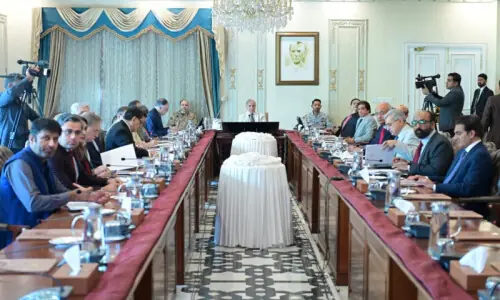
DHAKA: South and Southeast Asian countries agreed on Wednesday to create a food bank to combat shortages following natural disasters, a senior official said.
Bangladesh, which made the proposal at a two-day meeting of ministers and senior officials on easing poverty, was asked to come up with details at the next ministerial meeting in Kathmandu, Nepal, early next year.
“All the member countries of the Bay of Bengal Initiative for Multi-Sectoral Technical Economic Cooperation (BIMSTEC), unanimously agreed to create the food bank soon,” Mirza Azizul Islam, Bangladesh adviser (minister) for finance and planning told a news conference.
Bangladesh, Bhutan, India, Myanmar, Nepal, Sri Lanka and Thailand are members of the BIMSTEC.
“The member countries may contribute in kind or cash equally or according to their strength in the proposed food bank,” a senior official said. “But the modalities will be fixed in the next ministerial meeting early 2009,” Azizul said.
He said that the Dhaka meeting also adopted a resolution to share experiences and cooperate among the member nations in tackling environmental challenges.
“Natural calamities like floods, cyclones, drought - all have a severe negative impact on crops and non-crop agriculture production,” the adviser said, adding that global warming and climate change could produce dire consequences.
He said that an action plan would be drafted. “We have agreed to follow the best practices of each country for eradicating poverty,” he added.
Earlier, Fakhruddin Ahmed, head of Bangladesh's interim government, told the meeting that the Bay of Bengal group was a bridge between South and Southeast Asian nations in tackling natural disasters and harnessing economic potential.
“It brings together around 1.4 billion (people) or more than 20 per cent of the world population and represents a combined annual gross domestic product of $750 billion with a potential for trade volume to the tune of $43 to $59 billion,” he said.
Bangladesh called for cooperation among regional countries to ensure food security for vulnerable people in poor nations.
“Both food and oil are now big challenges for countries like us, and no one can face the challenges alone as these are a recent global source of tension,” Mirza Azizul Islam said.
“Efforts to cool soaring prices of foodgrains and oil are directly linked with the poverty alleviation programmes,” he said.
Ministers and government officials discussed strategies to alleviate poverty, such as substantially raising cereal output, a senior Bangladeshi official attending the meeting said.
“Each member state has undertaken various measures over the past decades to alleviate poverty with varied experiences as poverty varies from country to country and that will be shared,” Azizul said.
He said the dramatic increase in the price of foodgrains, fuel and fertiliser had given rise to “ugly inflation” and food supply was under strain.
“These factors add urgency to effective regional cooperation to meet the threat to food security,” Azizul said, adding that countries should also explore trade and business opportunities.
Large countries such as India, Pakistan and Thailand could liberalise their markets, which would enable poor countries to increase their exports.
“The South Asian countries could raise their annual trade volume up to $20 billion from a little more than $3 billion now, if they cooperate closely,” Azizul said.
“For example, Bangladesh’s import bills from India for the just-ended fiscal year (July-June) will be more than $2.5 billion when we have earned less than $500 million by exporting our products to that country,” he told reporters.
He urged BIMSTEC countries to adopt a balanced external trade policy for the region to help achieve the millennium development goal of reducing poverty by 50 per cent by the end of 2015.—Reuters