0
0

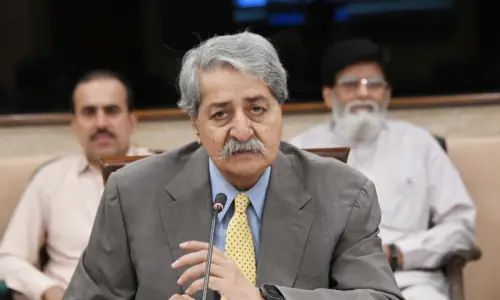
KARACHI, July 2: Federal Finance Minister Syed Naveed Qamar is reported to have told frankly a delegation of four top leaders of the textile industry on Wednesday that the government does not have any fiscal space in the budget to provide any relief on 68 per cent increase in gas supply tariff to their installed captive power plants.
According to one of the leaders of the industry, the federal minister acknowledged the financial stress coming on the manufacturing sector from the decisions taken by the Oil and Gas Regulatory Authority (Ogra) and that textile sector is the biggest employment provider and foreign exchange earner of the country.
“Give some practical proposals that can give you some relief,” the minister reportedly advised the team of All Pakistan Textile Mills Association (Aptma).
A four-member team of industry leaders has been formed to frame proposals to seek relief from the impact of 68 per cent increase on gas tariff for captive power plants.
“We hope to complete our work in the next two to three days,” one of the industry leaders told Dawn on Wednesday.
At the Aptma office, two meetings were held: the first one being the meeting of the Aptma managing committee and the second one a combined meeting of the leaders of about a dozen textile associations that discussed the impact of 68 per cent increase in gas tariff.
Through a resolution, the industry rejected the Ogra decision to enforce two slabs of gas tariff on industry.
For captive power generation, the tariff has been increased from Rs250 to Rs422. Ogra increased the tariff by 31 per cent on gas for general consumption mainly for boilers. “It is now Rs329 from Rs250,” a source confided.
The meeting also took notice of discrimination in Ogra’s decision which exempts Independent Power Producers (IPPs) from any increase in gas tariff but targets the industry.
The meeting demanded an end to this discrimination and it was stated that both the IPPs and captive power plants be treated at par.
According to industry sources, gas consumption by the IPPs is about 15.60 per cent while the textile industry consumes about 30 per cent of total gas.
Of this, about 19 to 20 per cent of gas is being consumed by electric power generators and eight to nine per cent by other users, mainly by boilers.
Industry leaders express the hope that some amicable solution could be found and indicate that the IPPs may also be brought at par in gas tariff hike which would divide financial burden between the two vital sectors of economy. Any increase in gas tariff on IPPs would make an impact on the Water and Power Development Authority and Karachi Electric Supply Corporation.