



 0
0

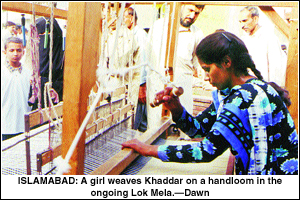 ISLAMABAD, April 17: Young Zubeida is seen busy teaching embroidery to girls of her age at the Balochistan pavilion in Lok Virsa.
Zubeida and her fellow students’ visit to the mela has been sponsored by the Balochistan government to demonstrate that education can motivate women of the tribal societies to seek better future and move up the social ladder.
Zubeida from Hazarvgi tribe is typical of a tribal artisan, who desires to become empowered through education. She wants to go for higher education, “as far as I can go in the university education”.
She is equally keen to share knowledge with the members of her sex. To achieve this objective, she has taken up teaching at Mominabad Girls School in her area, and runs a embroidery school in the evening.
She has about 20 students, who also study in schools and colleges and her following in the footsteps of their teacher, Zubeida in becoming economically productive members of the society, family and country.
The Hazarvgi stall is stocked with dolls dressed in regional costumes from several regions of Pakistan. The dolls are encased in glass set against the natural scenery of the area, embossed through hand painting. Zubeida told Dawn the dolls’ costume as well as the embossed scenery was all her work.
A student Tayyaba, at the stall, of the same tribe was preparing a tribal tunic called ‘kalago’ daintily stitched with floral embroidery called ‘khumki’. Other girls were knitting waist coat called ‘khab tumar’ in their tribal vernacular. Jewellry worn with the above outfit is called ‘silsila’ inspired from neighbouring Iran.
Zubeida proudly remarked that fame of her knitted embroidery work has crossed frontiers and she has been getting orders from as close as Lahore and from as far as Saudi Arabia and Singapore.
She learnt to embroider and stitch from village elders and improved on the inherited knowledge to supplement the family income.
She shares the income with her students who work with her. “A students gets Rs300 for every hand-knitted dress that is sold for Rs500”. One student is able to earn about Rs5,000 monthly, almost equal to what Zubeida earns.
The students said that they were not afraid of competition from machine-made products. ‘Machines could not match the quality of hand-made embroidery and stitching’.
Nilofer, a craft enthusiast, who is in the business of empowering women through business skills was very excited about Zubeida’s work.
She introduced each girl working at the stall to the visitors with the comments that the husband treats her with dignity and everyone in the household consults educated women who earns for the family.—Jonaid Iqbal


























