0
0

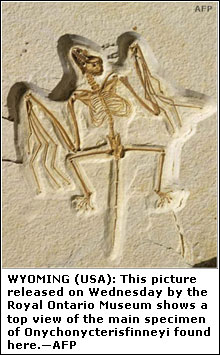 PARIS, Feb 13: A nearly perfect bat fossil unveiled on Wednesday, the oldest ever found, has settled a long-simmering evolutionary debate: first came flight, and only then did bats develop sonar to track and trap their prey.
Most experts had thought it was the other way around, according to the study, published in the British journal Nature.
Echolocation — the ability to emit high-pitched squeaks and hear the echo bouncing off flying insects as small as a mosquito — was assumed to be what made a bat a bat.
There are over 1,000 species of bats in the world today, and all of them can ping the air with sound waves.
But some, especially larger fruit bats, depend on their sense of smell and sight to find food, showing that the winged mammals could survive without their amazingly capacity to gauge the location, direction and speed of flying creatures in the dark. Dug out of limestone deposits in the state of Wyoming in the western United States in 2003, the new find is in a category all by itself, giving rise to a new Genus and Family.
Its large claws, primitive wings, broad tail and especially its underdeveloped cochlea — the part of the inner ear that makes echolocation possible — all set it apart from existing species.
It is also radically different from another bat fossil unearthed in 1960, Icaronycteris index, that lived during the same Early Eocene period.
Most experts had favoured an “echolocation first” theory because this earlier find, also from the Green River geological formation in Wyoming, was so close in morphology to modern species.
A team of researchers led by Nancy Simmons of the American Museum of Natural History baptised their find Onychonycteris finneyi, based on the Latin name for “clawed bat,” in honour of its unique prehensile feet.
They were amazed to find that, despite its underdeveloped hearing, O.finneyi apparently did not have a taste for fruit.
“Its teeth seem to show that it was an insect eater,” said Kevin Seymour, one of the authors and a palaeontologist at the Royal Ontario Museum in Canada.
“And if it wasn’t echolocating then it had to be using other methods to find food,” he said.
The next big question to be answered, said Seymour, is when and how bats made the transition from being terrestrial animals to flying.
O. finneyi’s primitive wings — more suited to gliding than flapping — provide a clue, he said, but until scientists find an even earlier ancestor, all they can do is speculate.
If they do find another specimen, there’s a reasonable chance it will be Green River site, which has yielded a treasure trove of intact fossils over the years.—AFP