



 0
0

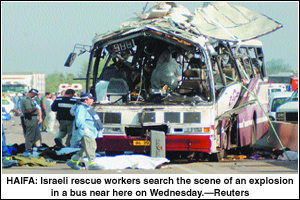 HAIFA, April 10: A Palestinian suicide bombing killed eight passengers on a bus in Israel on Wednesday and a defiant Israel pledged to press on with its West Bank offensive, dealing a double blow to a US peace mission.
Palestinian officials said the blast on a bus from the northern city of Haifa to occupied Al Quds shattered Israel’s argument that the 12-day-old sweep through the West Bank would bring security to Israelis shaken by a spate of suicide attacks last month.
But after the bombing, which scattered body parts across 250 metres of highway near Haifa, Prime Minister Ariel Sharon’s cabinet decided the military offensive that has killed at least 200 Palestinians would continue.
The Hamas claimed responsibility for the bus attack, saying: “The operation, launched from the heart of our besieged cities, is a slap in the faces of the criminals of the Zionist war.”
Besides the bomber and the eight others killed on the bus, at least 12 people were wounded.
“I saw people blown out of the windows by the force of the explosion...I saw hands and legs and other body parts on the road,” witness Eli Levy said.
The explosion on the bus crushed the front of the vehicle and ripped open its roof like a tin can.
“The Palestinian Authority seems to have an unquenched thirst for terror,” said David Baker, an official in Sharon’s office, placing overall responsibility on Arafat.
Ahmed Abdel-Rahman, general secretary of the Palestinian Authority, said: “The Haifa attack proves the failure of Sharon’s sweeping invasion in Palestinian territories.
“No preventive wall, full-scale war, or massacres will afford security for the Israelis,” he said. “Only peace can give security for both Palestinians and Israelis.”
PRIEST SHOT IN CHURCH: In Bethlehem, an Armenian priest was shot and seriously wounded in the besieged Church of the Nativity. It was not clear who shot the priest, who has been trapped along with some 50 clergymen and dozens of other people — some of them armed — since Israeli forces surrounded the shrine over a week ago.
Palestinians in the church accused Israeli troops of firing into the Armenian part of the church and wounding Father Mahir Arman.
The Israeli army said the priest was shot as soldiers were transferring food and medicine to the clerics inside. It pointed out that Palestinians have been deployed on nearby rooftops. Israeli snipers have also taken up positions.
In Jenin refugee camp, scene of some of the bloodiest battles since the West Bank sweep began, a senior Palestinian official said men surrounded by Israeli soldiers had stopped fighting.
President Bush has demanded Israel pull out “without delay” from all Palestinian areas seized in the offensive, launched after a suicide bomber killed 27 people in an Israeli hotel last month during a Passover holiday meal.
A nine-day lull in Palestinian strikes inside Israel had coincided with the Israeli operation in West Bank cities, villages and refugee camps. Government officials had said the respite showed the offensive was working.
Israeli forces withdrew from two West Bank cities on Tuesday. The Palestinians dismissed the pullbacks from Qalqilya and Tulkarm, still surrounded by Israeli forces, as a lie and a manoeuvre.
The Palestinian death toll from fierce battles in the narrow alleyways of the Jenin refugee camp was expected to be high.
Witnesses said many corpses lay in the streets after days of house-to-house fighting and Israeli bombardment. Palestinian officials have estimated more than 100 people killed.
The Israeli army said a soldier was killed in fighting in the camp on Tuesday night. Near the town of Anabta, in the West Bank, on Wednesday, a Palestinian was killed by Israeli tank fire and a woman was shot dead in Ramallah, Palestinian security officials said.
Eighteen months of the intifada and a recession have been taking their toll on the Israeli economy. Israel’s finance ministry said on Wednesday it was proposing steep spending cuts and small tax increases to offset a surge in defence costs.
Most private economists predict zero or near-zero growth this year after a 0.6 per cent contraction last year.—Reuters




























