0
0

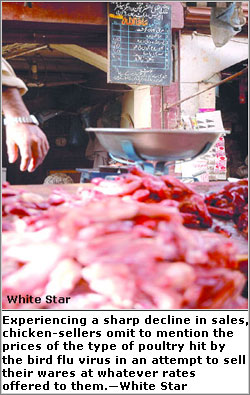 KARACHI, Feb 2: The outbreak of bird flu and Newcastle disease at a local farm has caused concern among the consumers and health experts, particularly in a situation when there is no set of by-laws or rules to regulate the poultry activities in the city or province.
A random survey by this reporter showed that people were extremely concerned about the quality of chicken meat.
The respondents said that the government’s department concerned had no tool to take into account the poultry farmers or check the status of birds or the manner birds are sold in the market.
A Karachi University teacher questioned the farmers’ claims that there was no negative impact on the retail sale of birds and the market rate of poultry was stable despite the confirmation of the H5N1 disease in the birds of the city, adding that they should assess the situation after surveying the market.
An employee of a private farm said that the rate fixation was done by the farmers, while the situation on the ground was that people were not willing to buy chickens at the moment. Shopkeepers are of the view that had there been any regulation for the establishment and operation of poultry farms, there would be little room to doubt the status and quality of chickens supplied to the market.
‘By-laws ready’
When contacted, the District Officer (Poultry) of the CDGK, Dr Asadullah Shah Bukhari, said that a set of draft by-laws had been prepared for registration and regulation of poultry farms aimed at the promotion of safe poultry activities in line with international standards.
While the government had no authentic figures on the poultry establishments in the city, it is assumed that there are 250 to 350 broiler bird farms and about 300 layer bird farms spread across the city. On average, 400,000 birds are slaughtered daily for domestic and commercial consumption.
Dr Aslam Jalali of the Livestock Department said that though there had been a loose system of monitoring poultry production, producers in their own larger commercial interest tried to ensure the rearing of birds in a hygienic and healthier environment.
Medical professionals, including Dr Qaiser Sajjad, the former general secretary of the PMA Karachi, called for the introduction of a system leading to the registration and regulation of poultry farmers and proper inspection of their farms by competent teams of technical experts.
Other experts said that birds would always remain prone to diseases in the province as most of the poultry farms did not maintain well-covered and purposefully built sheds.
“Most farmers of the province have not been able to establish any environmentally-controlled farms and prefer to keep birds in open sheds without proper roofs or huts and as such, the chances of contamination to the birds’ environment and their food increases manifold,” a government poultry doctor said, requesting anonymity.
A bundle of issues
“There are issues like poultry waste disposal, destruction and disposal of dead animals, distance between two farms and sheds as well as quality of breeds and feed for chickens, health and protection kits available with the poultry workers and how skilled or trained they are in handling poultry, which need to be addressed to gain the confidence of buyers and prevent the spread of diseases among the birds,” he added.
Another expert said that each poultry farmer must file a list of the programmes and health calendars of their farms, including the type of vaccines administered and diseases caused to birds, if any.
A Food and Agriculture Organization (FAO) paper, emphasizing that the protection of poultry was in fact the protection of people, says that good hygiene practices helped protect a flock against avian flu.
Dr Ali Akbar Soomro, Director Poultry of the Sindh Government, said that the government wanted to improve the state of affairs in the poultry sector as the health of the end users of the birds was of prime importance. “Since the situation is alarming, we will have to redouble our efforts towards the introduction of some legislation on the registration and maintenance of poultry farms,” he said, adding that a meeting with the stakeholders had been planned for next week, where the healthy production of birds and their marketing would also be discussed.