0
0

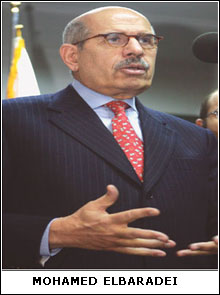 TEHRAN, Jan 11: UN nuclear watchdog chief Mohamed ElBaradei was holding talks in Tehran on Friday, seeking answers over Iran's contested nuclear drive in his first visit to the country in over one-and-a-half years.
ElBaradei began talks with Iran's atomic energy organisation chief Gholam Reza Aghazadeh on the first day of his two-day trip, according to state news agency IRNA, and is expected to see President Mahmoud Ahmadinejad on Saturday.
His visit comes amid talks between the International Atomic Energy Agency (IAEA) and Iran aimed at resolving questions over the history of the Iranian nuclear programme, which the West fears could be diverted to weapons use.
The United States is maintaining pressure for a third set of UN Security Council sanctions to punish Iran's nuclear defiance, but Tehran is hoping its cooperation with the agency will stave off further punitive measures.
“Relations between Tehran and the IAEA entered a new stage due to Iran's active cooperation over the settlement of important and basic questions in the nuclear issue,” the deputy head of the Iranian atomic energy organisation Mohammad Saeedi IRNA.Despite a four-year probe into Tehran's atomic drive, the IAEA has never been able to confirm whether the programme is peaceful. The aim of its latest talks with Tehran is to finally draw this investigation to a conclusion.
“We hope that ElBaradei, after seeing the reality, will make a positive and realistic report and close our case completely at the agency,” cleric Ahmad Khatami told worshippers at Tehran Friday prayers.
ElBaradei, who is accompanied by IAEA deputy director general Olli Heinonen, may also talks with supreme leader Ayatollah Ali Khamenei on Saturday.
He hopes the visit will help in “resolving all remaining outstanding issues and enabling the agency to provide assurance about Iran's past and present nuclear activities,” IAEA spokeswoman Melissa Fleming said this week.
A recent US intelligence report said Iran halted a nuclear weapons programme in 2003, undermining repeated accusations from US President George Bush that Tehran was actively seeking the atomic bomb.
The report appears to have momentarily taken the heat out of the atomic crisis but Washington still wants the UN Security Council to adopt a third set of sanctions against Tehran.
The Security Council has repeatedly called on Iran to freeze the sensitive process of uranium enrichment — which can be used both to make atomic fuel and a bomb.
But Iran has repeatedly said it has every right to the full nuclear fuel cycle and insists its programme is solely aimed at generating electricity for a population whose fossil fuels will eventually run out.
ElBaradei last visited Iran in April 2006, where he failed to win any concession from Tehran over the question of enrichment.
Bush, speaking on his first visit as US president to Iran's regional archfoe Israel, underlined his belief that Tehran remained a threat to world security.
“Iran was a threat, Iran is a threat and Iran will be threat to world peace if the international community does not come together and prevent that nation from the development of the know-how to build a nuclear weapon,” said Bush.
Even after the release of the intelligence report, the enmity between the two foes was made clear when Washington accused Tehran of harassing its ships in the Straits of Hormuz last week.
Iran and the IAEA have already held talks over three areas of past doubts — uranium particle contamination, Iran's past experiments with plutonium and its use of uranium-enriching P1 and P2 centrifuges.
The talks are in line with a timetable agreed by both sides in August for Tehran to provide more information over various areas of ambiguity in its nuclear programme.
Vienna-based diplomats said talks would now turn to the possible military use of Iran's nuclear technology, that last and possibly most significant item on the list.—AFP