0
0

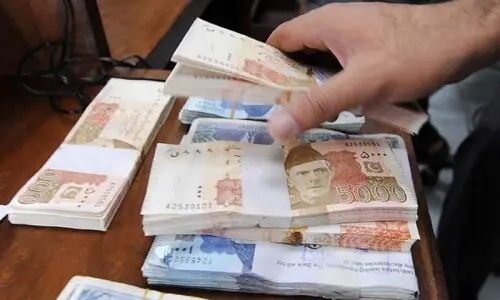
KARACHI, Jan 10: The rupee is expected to recover from a six-year low against the dollar once the political situation stabilises, the central bank governor said on Thursday.
The rupee, which closed at 62.55/60 to the dollar on Thursday, has lost about three per cent since November 3, 2007 when President Pervez Musharraf imposed a state of emergency in the country which was revoked in mid-December.
“We are hoping that as soon as this political confusion is settled the exchange rate will revert back to its original range, which was in the range of Rs60.60 to Rs61.50 to a dollar,” State Bank of Pakistan Governor Shamshad Akhtar told Reuters in an interview.
So far, the central bank has sought to pacify the market through “very limited intervention,” she said.
How soon the currency recovers will depend on how quickly the political and economic situation in the country settles down, said Akhtar.
Akhtar said that the central bank will unveil its monetary policy for the first half of 2008 on January 29. “Monetary tightening will continue, and the intensity of it will depend on us receiving more data than what we have today,” she said.
“For the last two years we have been saying: please read the message of the central bank, the central bank of Pakistan will remain in a monetary tightening phase,” she said.
The central bank adopted a tight monetary stance in recent years, increasing interest rates and reserve requirements to curb inflation. The annualised rate of inflation, measured by the consumer price index, was running at 7.85 percent for the five months through November, higher than the government’s target of 6.5 percent for 2007/08 (July-June).
Last week, the central bank cut its economic growth forecast for fiscal year 2007-08 to 6.6-7.0 per cent, lower than the government’s target of 7.2 per cent.
But Akhtar said the economy’s resilience had been tested several times already, and she was not alarmed by rising external and fiscal deficits as it was not unusual for developing countries to run a dual deficit.
The fiscal deficit for July-September quarter was recorded at 1.6 per cent of GDP.
The current account deficit stood at $4.8 billion, or about 3 per cent of gross domestic product (GDP), for the five months through November.
“We should be really looking at the capacity of the government to maintain a sustainable macroeconomic imbalance. There, fortunately, the government has more sustainability than meets the eye,” she said, adding that foreign currency reserves were adequate for now.