0
0

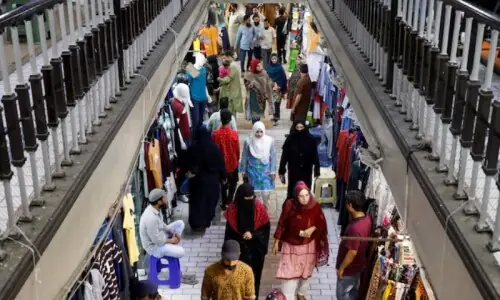
 KARACHI: The city’s District East, which has five National Assembly seats (252 to 256) and 12 provincial assembly seats (115 to 126), was established in 1974.
The district can be termed the hub of both education and industrial productions in Karachi as four major seats of learning -- the University of Karachi, NED Engineering University, Sir Syed University of Engineering and Technology and the Aga Khan Medical University -- are situated in this district.
Besides, the largest industrial zone of the city, spread over Landhi and Korangi, is in this district where more than 1,200 big and small industrial units are set up, producing cloth, leather goods, food items, medicines, chemicals etc.
The National Refinery and the Pakistan Printing Corporation are also located in the area and hence it is a major contributor to the national economy and the biggest employment generating district in the province.
The district has six sub-divisions: Jamshed Quarters, Ferozabad, Gulshan-i-Iqbal, Shah Faisal Colony, Landhi- Korangi and Model Colony.
Although there is no space left for cultivation of vegetables and development of fruit orchards, it has attractive recreational spots such as Safari Park, Aziz Bhatti Park, Aladin amusement park and Hill Park.
The other places of attraction in the district include the Quaid-i-Azam’s mausoleum, the Liaquat National Library, the National Stadium and the Pakistan Television Centre.
The district is spread over 139 square kilometres and lies between the Lyari and Malir rivers bounded by District Central in the north and north-west, District Malir in its East-South and in the West by District South.
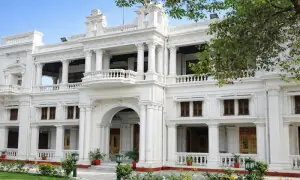
The housing societies which were developed in the district present a mixture of the old and new architecture.
The people here are politically more aware than any other district as it has over 75 per cent literacy rate, and over 60 per cent of population comprises middle- and upper-middle classes while 25 per cent falls in the category of lower-middle class and the rest belong to the working class.
Population-wise, over 70 per cent people speak Urdu, 15 per cent Punjabi, 10 per cent Sindhi and Balochi and over 6 per cent speak Pashto.
The eligible voters in the district for the five seats of the National Assembly, according to the election commission’s list, are 1,706,577 – 970,029 males and 736,548 females.
In the last elections, the total number of registered voters in the district were 1,211,044. Of the five seats, three were bagged by the Muttahida Qaumi Movement as its nominees Nawab Mirza, Mehmood Ahmad Qureshi and Iqbal Mohammad Ali Khan were elected from NA- 254, 255 and 256, respectively, while from NA- 252 and 253 Mohammad Hussain Mehnati and Asadullah Bhutto of the Muttahida Majlis-i-Amal were elected.