0
0

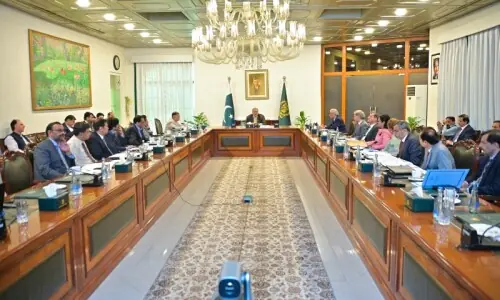
THE Frontier government has set up a working group to suggest short-term measures for attracting investment and promoting economic growth in the province. With representatives from government departments, commercial banks and business community, the group is headed by caretaker Finance Minister Muhammad Azam Khan. It will finalise its report in two weeks.
According to its terms of reference, the group will take initiatives for improving investment environment, identifying areas for fast track development, promoting growth of mines and minerals and enhancing interaction with private sector.
The economic managers of NWFP who are well-versed in the economic potentials and its constraints, argue that the caretaker government will hardly have the opportunity to take any policy initiative on the report of the working group. But, they agree it could benefit the next elected provincial government.
The NWF lags behind in industrialisation as compared to Sindh and Punjab. But because of the changed geo-political situation, its proximity with Afghanistan and the Central Asian Republics (CARs) it has now attained an advantageous position.
The successive governments failed to ensure industrial growth in the NWFP partly because of its disadvantageous location. It is far away from the port.
According to official statistics, currently out of 1,964 industrial units only 1,227 are functional, while 737 are either closed or non-operative. The total investment in the manufacturing sector is Rs54 billion, a major portion of which is now a dead capital.
The Frontier is blessed with treasures of marble, granite and gemstone that can form a base for a sustainable economic growth. According to the Directorate of Minerals NWFP data, the province has huge deposits of cement at three different sites. Keeping in view the size of the deposits, if a cement plant is established at each of the three locations, it could produce 3,000 tonnes of cement daily which could be exported to Afghanistan and the Central Asian Republics.
Likewise, gypsum-based industries can be set up at Kohat and Karak, which can produce 60,000 tonnes of products used in building construction annually. Kohat and Karak districts also have deposits of over 100 million tonnes of Caustic Soda/Soda Ash, where an industry can be set up to produce 50,000 tonnes of the product annually.
Marble granite is another important mineral available in the province. District Buner has four billion tonnes of marble and district Chitral has two billion tonnes of granite and serpentine. About 200,000 tons of tiles can be produced annually from these deposits.
Buner has a deposit of 6,000 million tonnes of Nepheline synite, one of the minerals used in ceramics industry, and has a capacity to produce 30,000 tonnes of ceramics annually.
Hazara division has over 10 million tonnes deposits of heavy manesite refractory having 20,000 tonnes annul production capacity. Moreover, Pezu, D.I.Khan and various parts of the Hazara division have very large deposits of silica from which 20,000 tonnes of glass sheets can be produced annually.
There are also a number of region-specific industries like match, furniture, pharmaceutical and food products that have vast potential for export.
The former MMA government had announced an industrial policy in 2005, which gave certain incentives to the investors in the shape of exemptions in property tax, social employees’ security, labour inspection and a 25 per cent rebate in electricity bills. But these measures did not yield any positive outcome.
Tourism is yet another important area that can be exploited for the greater economic benefits of the province. It has the potential to be the destination of tourists with a range of interests, providing thousands of jobs for the people of the province. The NWFP has much to offer in the shape of the landscape, biodiversity and sports.
Officials say peace is the main prerequisite for any type of business activity, but the prevailing circumstances don’t allow the investors to take the risk in a comparatively volatile region.
Citing the example of Pak-China Economic Zone, the officials explain the provincial government had many rounds of talks with the Chinese authorities, but it was unable to convince them to create such zones in Risalpur and Hattar because of security concerns.
Apart from security constraints, a poor road network, unabated power outage, lower ratio of lending by banks for business projects, lack of skilled labour and red-tapism in government departments hinder investment in the province. The newly formed working group has to address with all these constraints in its recommendations.