0
0

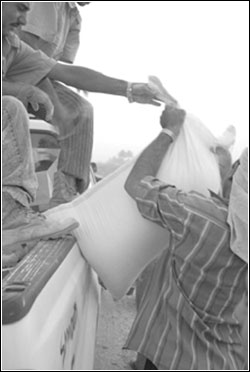 THE North West Frontier Province has once again been hit by a flour crisis amidst rising prices. As the province does not produce enough grain, it is always the worst hit in any food crisis, and more frequently. The situation worsens because Afghanistan depends on the NWFP market for its supplies.
Normally flour prices surge when supply falls short of demand. But this time the situation is quite different as a big stock of the commodity, probably more than the actual requirement of the local population, is available in the market, still its prices are keeping on fluctuating on daily basis.
Flour dealers complain that this is mainly because of price manipulation in Punjab from where they procure flour. They claim that prices of all types of flour have escalated by more than 50 per cent during the last two months. A 20kg bag of ordinary quality flour was available at R270 before the month of Ramazan. Now it is being sold between Rs420 and Rs430.
Haji Rambeel Khan, president of the NWFP Food Grain Dealers Association, explains that flour mills in Punjab are supplying wheat flour to the NWFP and Afghanistan in addition to meeting their own provincial needs.
The Punjab government, he says, issues subsidised wheat to mills which is supplied to the provincial market at a controlled rate of Rs285 per 20 kilogram bag. Flour at this rate cannot be supplied to the NWFP. As for markets outside Punjab, these mills have to purchase wheat from the open market where prices are comparatively higher than the official rate. If the Punjab government charges Rs1,250 per 100-kilogram wheat, its prices in open market ranges between Rs1,600-1,700. This consequently increases the cost of production which has to be borne by consumers outside Punjab.
Mr Khan explains that there are many factors involving volatility of wheat prices in Punjab, with ultimate impact on retail prices of flour in the NWFP.
Last week wheat shortage pushed up prices of flour to Rs450 per 20kg bag. However, with the arrival of imported wheat and increase in the daily quota, the prices have started coming down.
In Khan’s view, a uniform price of wheat flour is only possible if the federal government procures wheat stock from the market in accordance with the requirements of each province and releases the stock to flour mills.
The NWFP flour mills are seen nowhere in improving supplies to check the price spiral and bring stability in the local market. Some millers claim that they are the main victim of the whole crisis. Mr Naeem Butt, chairman of the All Pakistan Flour Mills Association, NWFP chapter, is holding the provincial government responsible for the recent price hike. He argues that the annual wheat requirement of the province is 3.1 million tones, whereas the provincial government procures hardly 0.25 million tones as strategic reserves.
“This quantity is insufficient to meet the growing demand of our local population, which ultimately leaves the consumers at the mercy of flour mills outside the province. Besides it makes the survival of flour mill industry almost impossible,” he maintains.
He recalled that in 1994 the provincial government was issuing 5,000 tones of wheat to local flour mills on daily basis. Now the size of the population had increased significantly, this quota should have been increased to around 8,000 tones. Instead of making a substantial increase, the provincial government had cut the daily quota of local mills to 1,500 tones.
The flour mills are now left with two options, either to shut down their operations because of limited supply of subsidised wheat, or purchase the commodity from open market at higher rates, he explains.
As most of the flour mills procure wheat from Punjab at higher prices, he claims that the mill have no ption but to export flour to Afghanistan and Central Asian Republics (CARs), where they can get a better price. Food grain dealers hold the millers equally responsible for the prevailing situation.
Haji Altaf Hussain, another office-bearer of the association, explains that the local flour mills are procuring wheat stock from the government at subsidised rates, although it may not be sufficient for the local market needs. But even then, the flour mills do not supply flour made of subsidised wheat to the local market and export it to Afghanistan and CARs. The NWFP government had directed the flour mills, which obtains wheat stock from official godowns, to sell their flour at designated fair price shops at Rs305 per 20 kg bag. But these directives are not implemented as consumers and dealers are complaining about non-availability of flour at these fair price shops.
Adam Khan, a labourer and sole bread earner of seven-member family, says whenever he visited the fair price shop he was unable to find a single bag of flour. The dealers believe that the millers do not give subsidised flour to these shops and smuggle it to Afghanistan.
Mr Butt, the Flour Mills Association chairman, clarifies: “The mills, procuring subsidised wheat from government, pump it to the local market, but the quantity is not enough.”
Allegations and counter allegations aside, the provincial government has completely failed to bring stability to the flour prices and keeping an institutional check on the market.
NWFP Chief Secretary Sahibzada Riaz Noor, during an inspection some two months back, had cancelled the wheat quota of a couple of mills for not supplying flour to the local market besides lodging FIRs against dealers responsible for the artificial shortage of the commodity. But no follow up action was taken to keep the flour prices within justified limits.
Apart from illegal movements, around 0.6 million tones of flour is exported to Afghanistan annually. The volume of legal and illegal trade has increased manifold and it is expected that by end of current financial year, exports would be more than one million tones. Interestingly, there is no bar on export of flour to Afghanistan, no permit is required from any of the official agencies and no foreign convertible exchange is needed, except a nominal customs duty at the Torkhum border.
Officials say the government is unable to either place a regulatory duty on flour export to Afghanistan or banning it completely mainly because both the decisions will have political repercussions, which it avoids at the cost of the consumers.