



 0
0

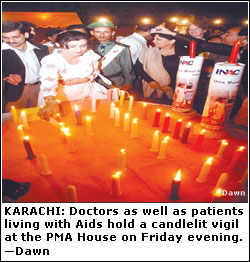 KARACHI, Nov 30: Speakers at a workshop on Friday urged the government to make laws for mandatory reporting of HIV/Aids, dengue and other infectious or communicable diseases by government and private hospitals.
The workshop was organised by the Sindh Aids Control Programme (SACP) in connection with the World Aids Day, observed on Dec 1 every year. The speakers focused on dissemination of reports pertaining to HIV/Aids surveillance in Sindh, which was conducted in four cities — Karachi, Hyderabad, Sukkur and Larkana — under a Canada-Pakistan surveillance project.
They stressed that a set of laws on communicable diseases would help government and health providers streamline the surveillance and an efficient management of such ailments.
According to a report based on integrated behavioural and biological survey covering a period up to Jan 2007, the overall HIV prevalence rate is alarming as it is 8.2 per cent among all high-risk groups, including sex workers and users of injectable drugs.
SACP programme manager Dr Arshad Mehmood Khan said that despite all out efforts, the anti-Aids workers had so far made no remarkable progress in reducing the gap between the reported and estimated numbers of HIV/Aids cases in the country. This could be attributed to the fact that the number of patients reporting at private hospitals was not being conveyed to the Aids controlling authority or any other central authority, they noted.
Dr Rafique Khanani of the Infection Control Society of Pakistan (ICSP) said that reporting of infectious diseases could help these authorities do an effective planning to bring the situation under control by fixing a target and chalk out an area-oriented management strategy.
In the absence of actual figures and necessary details concerning the affected groups or areas, there always remained the chances of anti-Aids workers making directionless efforts and available resources going to waste, Dr Khanani argued.
Director Development, Public Health, Sindh, Dr Khalid Sheikh said political commitment and an increased quantum of awareness in the masses was necessary for the success of any health project and interventions against communicable diseases. “Some time back, a set of laws was drafted by the health department but things could not be materialised as it was not taken well at the legislators’ forum,” he recalled.
Dr Qamar Abbas of the SACP said that the government should introduce and implement some ethical guidelines for the doctors who had undertaken treatment of Aids patients so that the stigma and the social taboos involved could be dealt with effectively.
Earlier, Dr Arshad Altaf, sharing the details of the second round of HIV/Aids surveillance in Sindh with newsmen, said female sex workers’ programmes had shown some positive results but other FSW typologies ought to be targeted in order to curtail transmission of the disease. In all, 4,812 blood samples were drawn in Karachi, Hyderabad, Sukkur and Larkana and the highest HIV prevalence rate of 30.1 per cent among IDUs (injectable drug users) was found in Karachi, followed by 29.8 per cent in Hyderabad, 16.5 per cent in Larkana and 5.3 per cent in Sukkur.
He also gave details of the HIV/Aids prevalence rate in male, female and eunuch sex workers.





























