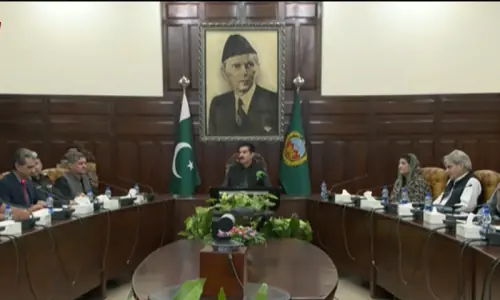
HYDERABAD, Nov 20: Eminent economist Dr Kaiser Bengali said on Tuesday that Pakistan had become a “national security state since 1977” where national security was the state’s primary objective, with “national” being increasingly narrowly defined to the point of being seen largely from the lenses of military’s political and economic interests.
Reading a paper at a national conference on “Pakistan - The vision of Quaid-i-Azam Mohammad Ali Jinnah” organised by the Pakistan Study Centre of the University of Sindh Mr Bengali said that Pakistan’s modern economic development process actually began in 1947.
He put this process in two distinct phases from 1947-1977 and 1977 to date and said that during 1947-1977 Pakistan was a “development state”, with socio-economic development as a primary objective of state policy.
Pakistan started out with less than a dozen medium-sized factories and the 60’s saw the development effort move into higher gear with the formation of the planning commission under the chairmanship of the president and the launch of ambitious second five-year plan, he said.
He said that this decade saw significant expansion of economic infrastructure in which construction of large dams commenced, new canals were dug and millions of acres of land brought under cultivation.
The industrial structure graduated from producing basic consumer goods to the manufacture of intermediate inputs for agricultural and manufacturing sectors during the period, he said.
Dr Bengali said that Steel Mills, Port Qasim, Indus Highway, Heavy Mechanical Complex, Heavy Electrical Complex, chemical plants, etc constituted huge additions to the country’s economic infrastructure and output capacity.
He said that commitment of the state to socio-economic development up to the end of 70’s could be discerned from the fact that the rate of growth of budgetary allocations to development expenditure increased at an annual average of 21 per cent during 1972-77.
He said Pakistan would need to create a policy combination of the 60’s and the 70’s to rebuild the economic base and resume its journey on the path of development.
The vice-chancellor of the University of Sindh, Dr Mazharul Haq Siddiqui, said that Quaid-i-Azam was a genuine ambassador of unity. But for his dynamic leadership, a separate homeland for Muslims would have remained just a dream, he said that basic change in the loyalties and emotional attachment of the erstwhile Indian Muslim nation was, first recognised and called attention to by Jinnah himself, while most other top Indian leaders (including Gandhi Ji) were calling on the Muslim minority in India to give “loyalty” tests.
Dr Riaz Ahmed, the director of the National Institute of Historical and Cultural Research Islamabad, said in his paper on “Quaid-i-Azam Mohammad Ali Jinnah and the Islamic State of Pakistan”, that Quaid-i-Azam decided to establish the state of Pakistan for which formal announcement had been made in March 1940 when the All India Muslim League in its Lahore meeting and demanded that the areas of the Indo-Pak subcontinent where the Muslims happened to be in majority such as in the North-West and the North-East should be grouped together in order to establish the Islamic State of Pakistan.
Eminent scientist Prof Dr Khushnood A. Siddiqui said in his paper on “A pragmatic recollection of Pakistan phenomenon: Myth and reality of a lofty dreamland and a tribute of innocence to the genius of Quaid-i-Azam Mohammad Ali Jinnah”.
Prof Lal Bakhsh Jiskani, visiting scholar of Pakistan Study Centre, University of Sindh, read his paper on “Post 9/11 environment: Extremism, violence, terrorism and bigotry”.