0
0

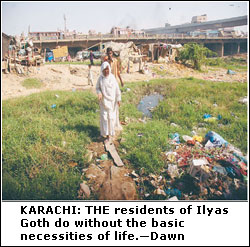 KARACHI, Nov 9: Naino and Radha, two women in their late 60s, live with their families under the Teen Hatti bridge. There are no well-defined boundaries to mark their homes. Wild animals roam about unhindered and children walk around with little or no clothes on to cover their bodies. The majority of the people who live in this area, called Ilyas Goth, are Hindus.
Life seems stark and hostile for the people who live here. There is one common bathroom that is used by all of them. Close to 125 people have no proper shelter as they were dislocated since rains ruined their shabby houses close to the nullah. Since the settlement is considered illegal they are constantly under threat of being evicted.
Government officials surveyed the area a few months ago and promised the settlers to rebuild their dwellings and to give houses to those who would have to shift from the place.
“Some of us had been allotted houses in Surjani Town. Yet when we enquired we found out that there is no truth in this statement made by the government,” said Radha.
“We have been living here for decades,” she added, while showing this reporter a dated ration card that was almost falling apart. “This is the card that was issued to my father. You can read the year on it,” she pointed out.
The small, two-roomed structures that used to be their houses are now filled with dried sewage and the roofs are no longer visible. The structures are now inhabited by mosquitoes, stray cats and dogs. Though the sewage has receded, there are good chances of it returning whenever it rains again. As for drinking water, they have to fetch it from the nearby houses. “We have no gas connections, no electricity and no drainage system in this area,” the residents said.
“The government officials keep visiting but do nothing to help us improve our living conditions,” said an old woman. “We are Hindus, and since we are minorities we are looked down upon,” added Naino with tears trickling down her cheeks. “If nothing can be done by the officials, then please shoot us and bring an end to our miseries once and for all,” she said grimly.
The families of Ilyas Goth make their living by making bouquets out of flowers that they buy from the nearby flower market at Teen Hatti or by making stuffed animal toys that are sold on the busy thoroughfares.
“We buy flowers for Rs300 and then, after making small bunches, we make a Rs100 to Rs200 profit after selling them,” said Krishna, a 25-year-old man. “We also make stuffed toys like lambs and bulls that you see being sold on the roadside,” he added. He said that since only a handful of people in the whole community are educated they cannot do much else.
As there are no schools in close proximity the children roam around aimlessly with nothing much to do. “We don’t have enough money to support the family. How should we educate our children?” questions Naino.
Most of the people here have more than six children. When asked if having fewer children would have helped, Radha, a mother of 11, said “We are illiterate people, we knew nothing about birth control methods. Otherwise we do realise how difficult it is to feed so many mouths,” she lamented. Furthermore, no one is certain about the future of the children who are born in these severe conditions.
“There is no doctor available for us in the area,” she protested. “And we cannot afford to take the sick to far-flung areas in a taxi or rickshaw,” said both the women. With nothing to shelter them from the stray animals and insects that breed in the nullah, they are quite prone to diseases.
Interestingly, both men and women work in order to make ends meet. “With inflation shooting up and hunger pushing us to the limits, even when both parents work children are often sent out at night to the nearby streets to beg in order to buy bread,” said Naino, a mother of nine.
Poverty and homelessness are not their only problems. Naino’s daughter suffers from domestic violence, inflicted upon her by her drug addict husband. “He comes and beats her and asks her for money. But what is even worse now is the fact that my grandson is also addicted,” she said. “I have to work in this age to support my daughter as she is pregnant and cannot work. I just wish that both the father and the son are put behind bars so that at least she can be saved from all the torture that she goes through.”
While there are only a few black sheep among the men of the community like Naino’s son-in-law who are heroin addicts, Naino herself takes refuge in niswar, which, according to her, is not only cheap but helps her stay active.
The residents of Ilyas Goth, who have national identity cards, neither have access to basic human rights like health and shelter, nor are they socially accepted as they belong to a minority community. Their existence and survival is a question the government should start giving attention to.