0
0

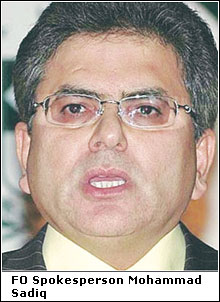 ISLAMABAD, Oct 22: The Foreign Office on Monday underscored that conflict resolution, nuclear restraint and conventional balance between Pakistan and India were the three vital elements for ensuring lasting peace between the two countries and in the region.
“If we have these three inter-linked elements in place in South Asia the relationship between the two countries could be established positively and on long-term basis,” said Foreign Office spokesperson Mohammad Sadiq while responding to a question at his first news briefing.
Noting that there were basically three inter-related elements which if addressed and established in this region, Pakistan and India could have lasting peace and positive relationship for a long time to come, he emphasized: “First and foremost is conflict resolution between the two countries, secondly there should be nuclear restraint and nuclear stability and thirdly there should be a conventional balance between the two countries.”
At the outset spokesperson Sadiq told the news briefing that during the expert level talks with India on Conventional and Nuclear CBMs last week Pakistan’s delegation had emphasized that the improvement in mutual confidence between the two countries should be leveraged to make sincere and concerted efforts for the resolution of outstanding disputes.
“A peaceful settlement of these disputes, in particular the Kashmir dispute, will lead to the beginning of a new era of mutual trust and cooperation in South Asia,” he said.
Referring to the second meeting of the Pakistan-India Joint Anti Terrorism Mechanism in New Delhi on Monday he noted: “Pakistan is cooperating internationally in the fight against terrorism. The Joint Anti Terrorism Mechanism with India focuses on cooperation between the two countries in order to prevent acts of terrorism and help bring perpetrators of such heinous acts to justice.”
Mr Sadiq said that Pakistan-India Composite Dialogue was a “very positive” process and that the two countries were moving in the right direction.
“Pakistan-India relations were never so good in last 60 years and this is for all of us to see,” he said.
However, on the question of the sluggish speed of the dialogue his explanation was: “First, diplomacy traditionally moves very slowly and secondly it’s a very complex relationship and in this complex relationship we should not expect results overnight.”
Commenting on the Indian prime minister’s statement that the dialogue process between the two countries had slowed down because of Pakistan’s domestic problems, he said: “The domestic situation either in Pakistan or India has nothing to do with the Composite Dialogue and would not affect the process. If the ruling alliance in New Delhi is destabilized at the moment it does not mean that the dialogue would go slow.”
He said that the dialogue had been slow as far as the core issue of Kashmir was concerned and Pakistan had been emphasizing the need to expedite that aspect of it.