0
0

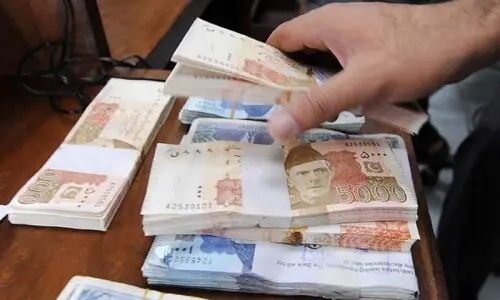
KARACHI, Sept 21: Heavy withdrawal from banks since the beginning of Ramazan put the money market under serious liquidity crunch forcing the banks to borrow from the discount window of the State Bank.
The regular siphoning of liquidity by the State Bank to maintain tight monetary stance in accordance with the monetary policy, was another major reason for liquidity crunch which compelled banks to borrow Rs19 billion from the discount window on Friday.Money dealers said since the beginning of Ramazan, the inter-bank market was in pressure mainly because of heavy withdrawals.
The shortage prevailed the whole week which ended on Friday as banks borrowed Rs110 billion from the State Bank.
“The inflow of liquidity is slow these days while the SBP continues to pick up the remaining liquidity through Open Market Operations (OMOs) which tightened the situation for the market,” said a dealer.
The shortage pushed the inter-bank money rate at the peak of 9.9 per cent just below the discount rate of 10 per cent.
Banking sources said the outflow of liquidity through paper was higher than average but it was much higher through credit cards, ATMs and debit cards.
They said the banks need massive inflow to meet the requirement of future needs as the Eid season was approaching closer.
Traditionally Eid season witnesses huge outflow of liquidity from the banking system, but soon they recovered after Eid as the market used to deposit what it earned during the season.
“The shortage will prevail and there was no chance for decline in inter-bank money market rate,” said a money dealer, adding if the SBP relaxes its continued tightening stance, the market could ease up.
However, most of money dealers said the demand would remain high and the money rates would be at the highest point till the end of the Ramazan season.
Analysts said during Ramazan, foreign exchange inflows used to go high as overseas Pakistanis send money back to their families.
Also, huge charities, including Zakat, were also remitted to Pakistan by the overseas Pakistanis. These inflows generate excess liquidity but the SBP does not allow the market to float with the newly-generated liquidity.
The money dealers said that small banks were more under pressure than the large banks as their deposit sizes are small and their advance to deposit ratios is very high.
The small banks have little room to face extra withdrawal of liquidity which forces them to borrow from the State Bank. Borrowing at 10 per cent is costlier for the banking sector and for small banks it would be an additional burden, said a dealer.