



 0
0

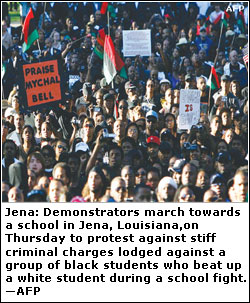 JENA (US), Sept 20: Tens of thousands of black Americans descended on a small town in central Louisiana on Thursday to protest what they say is injustice against six black teenagers charged over a high school fight.
Protesters arrived in buses and cars from cities as far away and apart as New York, Atlanta, Los Angeles and New Orleans for a rally in support of the “Jena 6”.
The case has become a symbol for many African Americans of a wider struggle against racism and perceived discrimination against black males by the criminal justice system.
“I came because enough is enough. I am tired of the way the courts have been treating African Americans historically,” said Doug Martin, a computer analyst from New Orleans.
Most shops were closed but organisers urged the protesters not to spend money in Jena so the town would not profit from what residents said was the biggest event in living memory.
Most of the demonstrators were dressed in black. Some held banners reading “Free the Jena 6” and chanted “no justice, no peace, no racist police,” while others lounged in lawn chairs or took pictures of each other.
The case stems from an incident in August of last year when three nooses were found hanging from a tree at the high school in the town of 3,000 northwest of New Orleans.
Black residents said that incident stoked tension in the town and in December the teenagers were charged with assault after a white schoolmate was beaten up.
Charges against some of the boys were later raised to attempted murder, drawing accusations from protesters that they had been excessively charged. Those charges have since been reduced.
CIVIL RIGHTS MOVEMENT
For many blacks the “Jena 6” has attained the status of a modern-day version of the incidents that punctuated the US civil rights movement in the 1960s.
Word about it has spread through the black community partly through syndicated radio shows by civil rights leader Al Sharpton and popular disc jockey Michael Baisden, but the case has remained little known among the wider US public.
The protest was originally timed to coincide with the sentencing of one of the students, Mychal Bell, convicted on charges including aggravated second-degree battery.
He was tried before an all-white jury which civil rights leaders said is itself evidence of discrimination.—Reuters



























