0
0

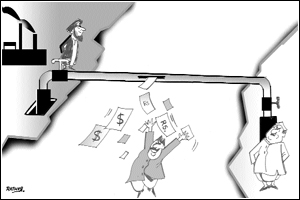 The recently revived Inter-State Gas Systems Limited (ISGSL) has geared up its effort to examine the gas import options from various countries through pipelines to bridge supply and demand gap and replace imported liquid fuels.
The ISGSL, a joint venture company, sponsored by Sui Southern Gas Company Limited (SSGC) and Sui Northern Gas Pipelines Limited (SNGPL), is revived after four years to look into the possibilities of importing gas mainly from Qatar, Iran and Turkmenistan. The ISGSL has also now been mandated to explore and develop overseas business opportunities.
SSGC holds 51 per cent share, while 49 per cent share is owned by the SNGPL in the ISGSL.
The ISGSL, after preparing country’s long term demand and supply position, will determine quantities of gas to be imported on a time scale basis, keeping in the developments in the country, using different assumptions of increase in local production of gas and other fuel. It will also undertake feasibility for the import of gas from various sources.
According to SSGC, Pakistan will have to import gas after six to seven years due to rising gap between the supply and demand.
There will be a gap between indigenous availability of gas and the pace of demand after six to seven years and Pakistan has three ample options import gas from Qatar, Iran and Turkmenistan.
In 2000, the gas demand for power, fertiliser, industrial, commercial and domestic consumers, were 2.7 billion cubic feet per day (BCFD). In 2005 it is estimated to rise upto 3.7 BCFD followed by 4.2 BCFD in 2010 and upto 4.6 BCFD in 2015.
On the other hand, the gas supplies from the existing and upcoming discoveries, which were 2.2 BCFD in 2000, will surge upto 3.1 BCFD in 2005, 3.4 BCFD in 2010 and 3.6 BCFD in 2015. As a result of this, the gap between demand and supply, which was 0.5 BCFD in 2000, will push upto 0.6 BCFD in 2005, 0.8 BCFD in 2010 and one billion cubic feet per day in 2015.
The current supply of gas is estimated at 2.4 billion cubic feet a day as against the demand of 3.4 BCFD. However, one billion cubic feet a day will be added to the national gas network in the two years but Petroleum Ministry feels that the new gas discoveries may hardly meet the rising demand, which is growing by six per cent per annum. As a result Pakistan has to import gas after six to seven years.
The government is now reviewing terms and conditions with the producers of gas in order to enhance the level of gas production by increasing their drilling activity both in off-shore and in-shore areas. However, the import of gas will become inevitable as the production from Sui gas field has already started declining and according to an estimate, its production will continue for another 10 years.
Petroleum Ministry has now pinned hopes on one of the three proposed regional natural gas pipeline projects — the Iran-Pakistan-India Gas Pipeline Project (length 1,650 km, diameter 48 inches and capacity three BCFD). Pakistan and Iran had already signed a memorandum of understanding (MoU) in February to undertake a pre-feasibility study for over a four billion dollars on shore route of the gas pipeline from Iran to India through Pakistan.
The two other projects are Qatar-Pakistan Gas Pipeline (length 1,600 km, diameter 44 inches and capacity two BCFD) and Turkmenistan-Pakistan Gas Pipeline (length 1,400 km, diameter 48 inches and capacity two BCFD).
People in gas industry feel that besides Iran-Pakistan Gas Pipeline, the Turkmenistan project is also expected to revive after a gap of five years following political change in Afghanistan.
There has been a renewed investors’ interest in the Turkmenistan pipeline project which was launched by the US energy company UNOCOL Corporation in the early 1990s but was deadlocked in 1998 when the US attacked Osama Bin Ladin’s network in Afghanistan after it was blamed for the bombing of two US embassies in Africa.
Pakistan and Afghanistan are now reported to have reached a political understanding on the Turkmenistan pipeline project after the visit of Hamid Karzai, chairman of Afghan Interim Government.
Turkmenistan has proven gas reserves of 101 trillion cubic feet (TCF) with production of 790 BCF and export potential of 590 BCF. Iran has proven reserves of 812 TCF with production of 1900 BCF. Qatar has proven gas reserves of 300 TCF with production of 690 BCF and export of 168 BCF.
The government is seriously pursuing these three gas import projects with main consideration of lower delivery price and quickest delivery time.
Analysis of Pakistan’s gas market indicates that power generation sector is going to be main consumer of the imported gas, augmented by household demand, manufacturing and other industrial needs.
Petroleum Ministry is of the view that the import of gas will provide multi-directional benefits to Pakistan like substitution of imported liquid fuel (fuel oil and kerosene oil), saving foreign exchange and the environment and relief to hardpressed infrastructure of ports, roads and railways used in movement of imported oil upcountry.
The advantages to the region are — shift towards gas-driven environment friendly energy economies, strengthen regional cooperation and provide a foundation for future economic growth throughout the region, significant direct and indirect economic benefits during the construction and over the life of the project through employment, transit fees, availability of clean fuel, economic and industrial growth and new business and investment opportunities.
Potential for natural gas substitution exists in the transport sector as the compressed natural gas (CNG) is now gradually replacing petrol and diesel and in power generation sector replacing fuel oil.