



 0
0

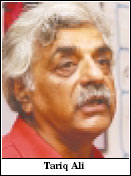 KARACHI: It was more than a tad ironic that Tariq Ali, a symbol of adoration for many on the Left of the political spectrum, stayed at the Sind Club, an elitist playground that is a manifestation of all things patrician, during his recent visit to Karachi.
“Well I was put up here by the people who organised the lecture,” he says, referring to the sixth Hamza Alavi Distinguished Lecture he gave in the city. “But where you stay and what you eat doesn’t affect me at all. If I had my way this place would be either a hospital for the poor or a school for girls. But I’m not in charge,” he adds, when asked about his choice of lodging.
This was just one of the many interesting things the writer, film-maker and former radical street fighting man had to say when Dawn caught up with him for a quick chat.
During the lecture, Tariq Ali said that he was dismayed each time he came to Pakistan when he surveyed the political situation.
“There’s a political cycle in Pakistan that’s been proceeding apace since 1958. That was the year we had our first military dictatorship. The life-cycle of these dictatorships is roughly 10 years. After that people get fed up with the military. Then they make an attempt to have democracy with civilian politicians. The politicians don’t deliver (either).
“We’re now observing a new dance. The different thing about Musharraf’s coup was that he realised he was operating in a different world. The Cold War was over and the needs were different. So instead of calling himself chief martial law administrator he called himself chief executive. Observing this from afar was very entertaining but very symbolic,” says Ali with a bemused chuckle.
“The latest dance we’re witnessing is a ballroom dance between Musharraf and Benazir Bhutto. (Musharraf) says if the deal is done (Benazir) will be forgiven all the corruption and all the graft. What right has a government to (say) that? But they’re doing it. It means they don’t really care about the rule of law, and that’s why I despair,” he observes.
Ali also thinks that the imminent threat of a fundamentalist takeover of Pakistan is overplayed by the Western media.
“We all know who these groups are. They came into being during the Zia period. They were created by the state. The massive influence of the state in creating new groups and encouraging groups that existed should not be underestimated. The rise of fundamentalism was not spontaneous which erupted from below. It was something that was encouraged from above.
“These dragon’s seeds became monsters. The regime used them in Afghanistan and Kashmir. Now it’s a tiny bit out of control. In my opinion, if the military wanted to stop it, they could but they don’t, because they’re very deeply implicated in it,” he says.
As for the nature of the Pakistani populace Tariq Ali says that “the bulk of our people are not fundamentalists. The middle class and upper middle class are a bit over worried because they’re seeing the growth of religiosity in their own ranks. But that’s happening all over the world as there is a big vacuum and there’s nothing to fill that vacuum, hence many people turn to religion.”
And what of Pakistan’s ‘liberal intelligentsia?’
“I don’t know if it’s accurate to describe it as an intelligentsia as one of the things that define an intelligentsia is its capacity to read books and analyse and to produce works which have an impact, either books, films or essays. I would say there are about eight to 10 people in the country who occasionally write very interesting stuff, but by and large I think we are decaying.
“Our education system is in a complete mess. It is not producing people who are being produced for instance in India or even in Iran under the clerics. The Iranian intelligentsia remains vibrant producing films that are now world classics. Nothing like that happens here.”
He illustrates his point using the example of a recently released, critically-acclaimed film.
“People get very excited because a film is produced with the help of the military called Khuda Kay Liyen. It has a few good lines in it but when I went to see it struck me as being a propaganda film. It reminded me of the bad propaganda films that used to be produced in the Soviet Union in the ’30s. ‘There are bad Muslims and there are good Muslims and we urge you to be good Muslims and love music.’ That’s about the level of that film.
“It may be well-intentioned compared to the rest of the rubbish produced by the Pakistani film industry, but let’s not call it a serious film. So when you talk about the liberal intelligentsia, be a bit cautions, as the problem with many liberals is that they are so enamoured with the United States by creating this fear that if we don’t fall on our knees before the US, the fundamentalists will take over. I don’t think this is likely. The fundamentalists are an alibi for the US, they’re an alibi for the (Pakistan) army and they’re an alibi for many liberals who operate here.”—QAM





























