



 0
0

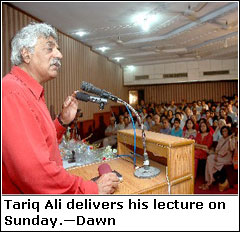 KARACHI, Sept 2: Giving a succinct account of the history of imperialism from before World War I up till the present day, writer and film-maker Tariq Ali said the single most significant event of the 21st century was the emergence of China as a major capitalist power on the world stage.
He was featured as the keynote speaker at the sixth Hamza Alavi Distinguished Lecture held here at a medical college. Titled ‘Contradictions of imperialism: tasks and prospects,’ the lecture was organised by the Irtiqa Institute of Social Sciences and the Hamza Alavi Foundation.
Mr Ali said China was now the “new workshop of the world,” just as Britain was in the 19th century. In his typical sublime yet biting style, he pointed out that after the events of Sept 11, 2001, when the US experienced a surge in patriotic fervour among the populace, there was a great demand for the American flag. Ironically, this demand could not be met locally and extra shipments of the Stars and Stripes had to be imported from China.
He said the strongholds of capitalism had shifted from the West to the East and he did not foresee a clash between the US and China, at least for the next 50 years, as both economies were dependent on one another and any conflict would be mutually harmful.
The rise of ‘ultra-imperialism’
Talking about the evolution if imperialism from the 20th century to the present, Mr Ali said that Marxist theoretician Karl Kautsky had predicted that the rival imperialist powers would give way to a single “ultra imperialism,” a view, he said, which was vociferously opposed by V.I. Lenin, who said competing imperialist powers would cancel each other out and give way to socialism.
The WWI seemed to justify Lenin’s stance, Tariq Ali said, but in fact history had vindicated Kautsky as today the United States was the “world’s only imperial power.”
Coming to Iraq, he said that it was crude to assume that the US had invaded that country simply to usurp its oil.
“The invasion was designed to assert US hegemony and to show America’s rivals that to have access to this energy, you have to come through us,” he claimed.
Talking about what he described as the ailing US economy, Tariq Ali said the American economy’s growth rate was now merely 1 per cent, and he quoted mainstream financial institutions as saying that it was susceptible to a 1930s-like slump. This, he said, was significant coming from mainstream sources, as earlier this was only heard from radical circles.
Asia’s quiescence
Asia was largely quiescent to American hegemony as people were more involved in making money while the poor were rotting. This would lead to an explosion, he said, adding that NGOs “can’t do the trick” as these organisations were merely pushing forward western agendas.
Tariq Ali said the only continent that was defiant was South America, specifically citing the examples of Venezuela and Hugo Chavez, along with left-inspired governments being voted into power in Bolivia and Ecuador, which was becoming a major headache for the US.
Citing Venezuela’s channelling oil revenues into social uplift projects, he said when Hugo Chavez appeared on Al-Jazeera, the channel was flooded with emails from viewers asking when the Arab world would produce a Chavez, as the Arab masses knew they were floating on a sea of oil.
“The Arabs have enough oil to provide free education up till university across the Muslim world if they wanted to and still make money,” he said.
He acidly commented that Pakistan was a pioneer in Asia when it came to clamouring for a place as an American satrapy, saying that the Asian states had only now started following our lead.
Before beginning his lecture Mr Ali talked about his association with the late Hamza Alavi and described him as one of the first radical socialist intellectuals.
The Hamza Alavi Foundation was also formally launched at the gathering to publish and disseminate Alavi’s work, support the causes which were dear to him and carry his work to the next generation.





























