0
0

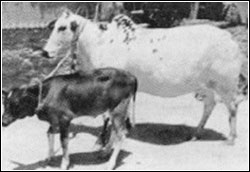 ISLAMABAD, Aug 21: Livestock scientists working at the Animal Sciences Institute (ASI) have successfully crossbred imported Jersey bulls with local cows, which have produced heifers that mature very quickly and their milk producing capacity is twice that of local cattle.
A team of Pakistan Agriculture Research Council (PARC) scientists involved in the project, at the Animal Science Institute of the National Agriculture Research Council (NARC), carried out the crossbreeding programme in local farmers’ herds at a number of locations.
The resulting crossbred offspring matured at an average age of 16 months only and produced 1,900 liter of milk during the first lactation. While, the local cows take about 30 months to fully mature and produce only 870 liter milk during lactation.
In order to meet the domestic requirements of future semen production, the NARC has imported a nucleus herd of Jersey cows from the USA to produce bulls. This nucleus herd is being maintained at the NARC, Islamabad.
More than 300 Jersey bull calves were provided, at cost, to cattle breeders for crossbreeding in the areas where no artificial insemination (AI) facilities exist, a spokesman for the PARC told Dawn.
He said the crossbreeding programme would not only improve milk production of cattle but also result in increased income for farmers.
The scientists of Pakistan Agricultural Research Council (PARC) are working closely with livestock farmers to improve the quality of local cattle breeds, as this sector has a great potential.
The PARC believes that the local cattle are generally low milk-producing breeds that take a long time to mature, have longer calving intervals and shorter lactation periods. Scientists say these shortcomings can be overcome and local cattle breeds can be improved by scientific interventions.
“Crossbreeding is a short and successful way to improve (the) country’s local cattle with exotic breed. The nondescript cattle can be crossbred with semen of exotic breeds for higher production of milk,” the PARC spokesman said.
A 35 million rural population is dependent on livestock production and the sale of milk. The livestock sector contributes to 11 per cent of the Gross Domestic Product (GDP).
According to the federal ministry of food, agriculture and livestock (Minfal), the total value of milk produced in the country during 2005-06 was higher in value than the two major crops —wheat and cotton. But, still due to increasing domestic demand, the price of milk has been increasing at an unprecedented pace, over the last one year and the trend could only be checked by plugging the gap between supply and demand.
The total number of cattle in Pakistan is about 45.5 million. Although 10 famous cattle breeds exist, out of the remaining ones, 70 per cent are nondescript.
Cattle have traditionally been used as a source of draught power in Pakistan, especially in the Potohar region. Their utility as draught animals is decreasing due to agricultural mechanisation. The nondescript cows yield hardly one to three liters milk per day. These cattle are now being improved genetically through crossbreeding, with Jersey semen, for getting higher milk yields.
The Jersey breed originated in the Island of Jersey, a small British island in the English Channel off the coast of France. They are one of the oldest dairy breeds, having been reported by authorities as being purebred for nearly six centuries.
The breed was known in England as early as 1771 and was regarded very favourably because of its milk and butterfat production. At that early date, the Jersey Island cattle were commonly referred to as Alderney cattle, although the cattle of this island were later referred to only as Jerseys. Jersey cattle were brought to the United States in the 1850s.
Adaptable to a wide range of climatic and geographical conditions, outstanding Jersey herds are found from Denmark to Australia and New Zealand, from Canada to South America, and from South Africa to Japan. They are excellent grazers and perform well in intensive grazing programmes. They are more tolerant of heat than some larger breeds.
With an average weight of 900 pounds, the Jersey produces more milk per pound of body weight than any other breed. Most Jerseys produce milk far in excess of 13 times their body weight during each lactation.