0
0

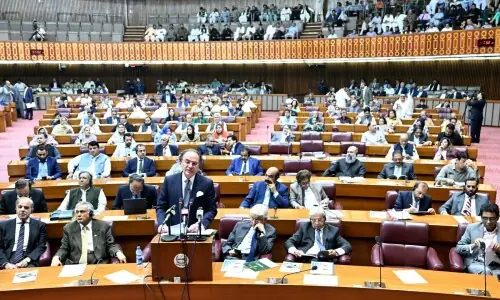
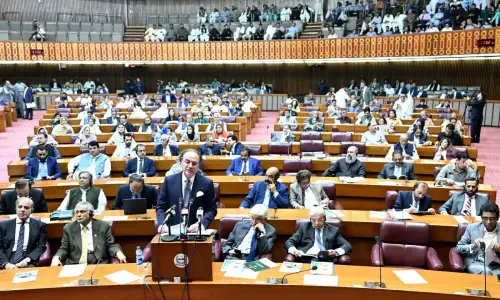
ISLAMABAD, Aug 17: The sale of human organs such as kidneys and their unauthorised transplantation will be punishable with up to 10 years in prison under a government bill introduced in the National Assembly on Friday to regulate organ transplants in the country.
The draft, which provides for a regulatory mechanism for the removal, storage and transplantation of human organs and tissues for therapeutic purposes and prohibits their sale by Pakistanis to foreigners, must now go to the National Assembly’s standing committee for the health ministry before coming back to the house for passage.
It appeared odd that the 18-clause bill was introduced on the last day of the session, which conducted no legislative business in its 19 days, while the next session, likely by next month, could be the last of the present house with prospects of being overwhelmed by other controversial issues such as the planned presidential election.
A statement of objects and reasons accompanying the government bill said that while Pakistan enjoyed a good reputation in the region for a high rate of success in transplant surgeries, particularly in kidney transplants, “unethical practices have emerged to the detriment of the patients, particularly the poor ones,” owing to the absence of an appropriate regulatory mechanism.
It said incidents of selling kidneys by “the poorest of the poor are on the rise” and added: “Patients from certain developed countries visit Pakistan to purchase organs for transplantation at local kidney centres. It has thus become imperative to put in place an effective regulatory mechanism to curb this menace and the exploitation.”
The new law will allow a voluntary organ or tissue donation by at least an 18 year old living person to “any other living person genetically and legally related, who is a close relative” such as a parent, son, daughter, sister, brother and spouse in accordance with a prescribed manner.
“In the case of regenerative tissue, i.e stem cells, there is no restriction of age between siblings,” it said.
The bill also provides for donation to be effective after death if a person aged at least 18 years authorises any medical institution or hospital approved by a 10 member monitory authority headed by the health minister and including heads of organisations of the medical profession and specialists.
It says transplants and removal of human organs “shall only be carried out” by recognised professionals after a written certification from an evaluation committee, one of several to be appointed by the federal government with medical specialists and notables of the area concerned.
The bill prescribes an imprisonment for up to 10 years and a fine of up to one million rupees for those involved in the removal and human organs without the prescribed authority as well as their sale. Contravention of other provisions of the law will be punishable with up to three years of imprisonment and a fine of up to Rs300,000.
A medical practitioner convicted for unauthorised removal of human organs for transplant will also be liable to “appropriate action” by the Pakistan Medical and Dental Council, including removal from its register for three years for the first offence and permanently for the subsequent offence.