



 0
0

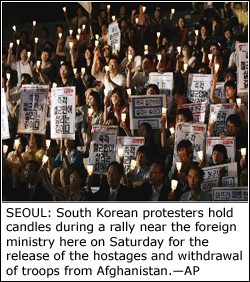 KANDAHAR, July 21: A spokesman for Afghanistan's Taliban claimed on Saturday the militants had killed two Germans and five Afghan hostages and threatened that 23 South Korean captives could meet the same fate.
But Afghanistan's foreign ministry and German Foreign Minister Franck-Walter Steinmeier said one of the Germans was still thought to be alive.
The other German had died but had not been murdered, Steinmeier said, while the Afghan ministry said he had died of a heart attack.
“Nothing indicates that he was assassinated — everything suggests he died due to the conditions of detention imposed by his captors,” Steinmeier told reporters in Berlin.“Now it's about saving the life of the second hostage,” he said.
Taliban spokesman Yousuf Ahmadi warned that the insurgents would kill 23 South Korean Christian aid workers by Sunday unless an equal number of jailed Taliban fighters were freed before then.
Ahmadi, speaking by telephone from an undisclosed location, said the Taliban had set the deadline for the South Koreans for Sunday 7:00 pm local time (1430 GMT).
“If the government does not free 23 Taliban prisoners, these will be the last moments of their lives,” he said.
The Taliban have also demanded that both countries withdraw their troops from Afghanistan, where about 3,000 German troops serve under Nato command and some 200 South Korean soldiers are deployed under US-led command.
The Korean Christians, most aged in their 20s and 30s, on an evangelical and aid mission, were seized while travelling by bus on Thursday, a day after the two Germans and five Afghans were seized.
Both groups were kidnapped on the Kabul-Kandahar highway which leads to the war-torn country's south, a hotbed of the Taliban insurgency against NATO and US-led forces.
The Seoul government said “up to 23” people in the South Korean group were abducted, of whom 18 are women.
The Koreans in their 20 and 30s left on July 13 for the staunchly Islamic country to “do evangelical activity and volunteer work” in hospitals and children's homes and were due to return home on Monday, their church said.
The Afghan government, meanwhile, denied Ahmadi's assertion that the two Germans had been killed by the insurgents.
“According to information from Afghan security organisations, one of the hostages died of a heart attack and the second is still alive,” said foreign ministry spokesman Sultan Ahmad Baheen.
“Efforts for his release continue,” he said.
Ahmadi in the evening declared that the five Afghan hostages abducted with the Germans had also been killed.
“One of them was (Afghan deputy assembly president) Arif Noorzai's brother,” said Ahmadi. “Their family can come and pick up the body without paying anything. It's all for free.” South Korea's President Roh Moo-Hyun on Saturday urged the immediate release of the South Koreans as Seoul also said it would withdraw troops from Afghanistan by the end of this year as scheduled.
“The kidnappers must return the South Koreans unharmed at the earliest possible date,” Roh said on national television before news of the reported killings. “Under no circumstances should there be any loss of life.” Officials in Seoul said they were seeking direct talks with the kidnappers, and a crisis mission was on its way to Kabul.
“We are maintaining contact with the militant group and seeking to expand contact with it through various channels,” a South Korean foreign ministry official told reporters on condition of anonymity.
Roh also indicated an apparent willingness to talk to the kidnappers.
“The Korean government is prepared to make its utmost effort with the relevant parties in order to secure the speedy release of the Korean citizens,” he said in a televised statement.
Roh stressed that the abductees had been engaged in aid activities.
“Innocent civilians must not be held as hostages,” he said.
All his country's deployed troops, he added, were either army engineers or medics helping to reconstruct Afghanistan.
Roh afterwards telephoned Afghan President Hamid Karzai and called for Kabul's cooperation.
Foreign Minister Song Min-Soon said earlier that the troops would be withdrawn by the end of the year as previously planned.
“Under the existing plan, we have only several months to go before the troops complete their mission and pull out,” he told reporters. “They can't simply pack up and leave immediately.”—AFP



























