0
0

LAHORE, June 18: Participants in a consultation meeting urged political parties to do their homework for running affairs of the country after the army’s ouster from politics as a result of the ongoing lawyers’ movement.
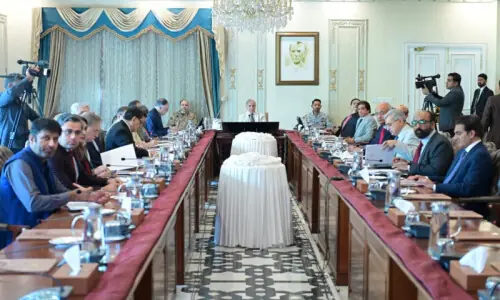
The Human Rights Commission of Pakistan at its auditorium here had arranged the meeting on ‘Political crisis, election prospects and quest for a consensus’ on Monday.
Former finance minister and PPP-SB leader Dr Mubashir Hasan said the parties should prepare themselves for the post-army scenario and should reach some understanding on the basic governance structure.
He urged the armed forces to play their role defined in the constitution.
He saw provincial autonomy as a must for the sustainability of the federation.
He showed his dissatisfaction at the prevailing governance system and demanded a change in it for empowering elected representatives in letter and spirit.
He said mullahs had no authority to impose their views on others as every citizen has the basic right to interpret and follow its religion.
PML-N MNA Khwaja Saad Rafiq regretted that political parties wanted democracy in the country but not in their own organisations as a result of which distance between leaders of a party and its activists was on the rise.
He feared eruption of a race among political parties for taking over reigns of power after the ouster of Gen Musharraf’s regime.
Former Punjab PML-N general secretary Zaeem Qadri said the nation would be justified to ask their leaders how they followed the charter of democracy they themselves had signed with a resolve to abide by it.
Seraiki Party’s Taj Muhammad Langah said the army was the biggest feudal lord in the country and warned that contesting election under Gen Musharraf would be a useless effort.
Istaqlal Party’s Manzoor Gilani was dissatisfied with the role of political parties in the current lawyers’ movement.
He said the army neither created the country nor saved it, rather played a rule in its dismemberment.
SAFMA’s Imtiaz Alam said the Chief Justice of Pakistan has filled the vacuum created by the absence of the self-exiled leadership in the local politics.