0
0

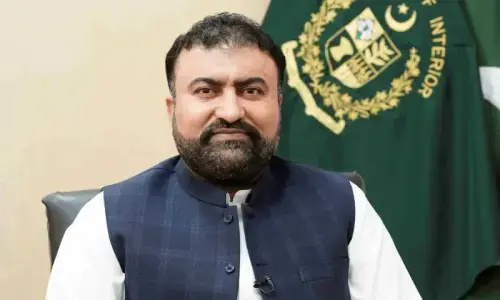
KARACHI, June 5: Scars from the May 12 violence in Karachi may still be fresh, but the government of Sindh has no plans to launch a deweaponisation campaign. This has been confirmed by Adviser to the Sindh Chief Minister on Home Affairs Waseem Akhtar, despite an earlier statement by Federal Information Minister Mohammad Ali Durrani.
While visiting the Lahore residence of the Speaker of the National Assembly Chaudhry Amir Hussain on May 17, Mr Durrani had claimed that the Sindh government would accelerate its deweaponisation campaign in Karachi.
However, Mr Akhtar said: “We have never taken a decision to launch a deweaponisation campaign in Karachi or in the province, although this point came under discussion in a meeting with President Musharraf. We have proposed some legislative amendments which we understand are necessary to bear fruitful results.”
The home adviser wondered why his coalition government was being pressurised to launch a deweaponisation campaign, when such a move was not made during the tenures of Nawaz Sharif or Benazir Bhutto.
He conceded that weapons flooded Karachi soon after the Afghan war in the early 1980s, and added that even now, the government has been unable to eliminate weapons smuggling despite strict checks along the provincial borders. However, he said, a strict check on the transportation and possession of unlicensed weapons could be achieved if the police were more efficient.
“Therefore,” he said, “we have proposed increasing police strength in Karachi and will give more importance to training police officials.”
Mr Akhtar said that “we have to bring changes in the law to discourage keeping arms as well as raise awareness. Additionally, the implementation of the existing punishment for keeping unlicensed weapons should be made effective.”
Meanwhile, analysts believe that the immediate launch of a deweaponisation campaign is essential but have little hope for the political will required to take this step.
In 2000, the then Interior Minister Moinuddin Haider took notice of the blatant display of arms in Karachi and other parts of the country, following which a countrywide deweaponisation drive was launched in 2001.
The campaign achieved some results in Karachi, where an estimated 27,000 unlicensed weapons were dropped into boxes placed outside police stations.
The government had announced an amnesty period during which no questions would be asked. Sources in the law-enforcement agencies and the government believe that the weapons were surrendered by people who did not have affiliations with any political or religious groups, and feared police raids.