0
0

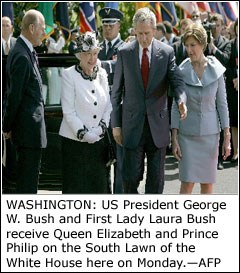 WASHINGTON, May 7: Queen Elizabeth of Britain avoided discussing the war on terror at a ceremony in the White House on Monday, choosing instead to focus on close relations between her nation and the United States.
Earlier, US President George W. Bush tried to make the queen comment on his efforts to fight terrorism, lauding Britain’s alliance with America in the global war on terror.
“Today our two nations are defending liberty against tyranny and terror,” he said. “We’re resisting those who murder the innocent to advance a hateful ideology, whether they kill in New York or London or Kabul or Baghdad.”
Mr Bush went on to praise the queen for her leadership in trying times.
“I appreciate your leadership during these times of danger and decision,” Mr Bush added. “You’ve spoken out against extremism and terror. You’ve encouraged religious tolerance and reconciliation. You have honoured those returning from battle and comforted the families of the fallen.”
In her remarks, however, the queen avoided discussing the war on terror, choosing instead to focus on celebrating “the close and enduring associations which thrive between the United States and the United Kingdom.”
“And now, in Washington, we have a further opportunity to acknowledge the present strength of our relationship,” the queen said. “I shall enjoy not only renewing old acquaintances and making new ones, but also recognising the breadth and depth of the friendship we have shared for so long.”
British officials have recently stopped using the term war on terror, preferring instead to emphasise the need to win over “Muslim hearts and minds”, as a senior British official recently said, by exposing the dangers of the extremist ideology.
Some US officials also have quietly abandoned the phrase “war on terror.”
At a speech on Monday at the Anti Defamation League, Homeland Security Secretary Michael Chertoff spoke of terrorism, terrorist network and extremists but did not use the phrase “war on terror”.
Last week, he said in a speech that the west was battling a movement that sought to “advance a totalitarian world vision” and that terrorism was one tactic used to reach that goal.
“If we don’t understand that and contend in the field of ideology, we cannot really match this enemy across the entire spectrum of the challenge,” Mr Chertoff said on Thursday at Johns Hopkins University.
The language change was also seen at the Pentagon where the phrase “long war” has been shelved since March, and in Congress where Democrats on the House Appropriations Committee agreed to stop using both phrases.
Britain instructed its diplomats to scratch “war on terror” from their lexicon.
“We can’t win by military means alone,” said International Development Secretary Hilary Benn. “And because this isn’t us against one organized enemy with a clear identity and a coherent set of objectives.”
Mr Bush, however, still uses the phrase war on terror and hopes to have a military victory over the terrorists.