0
0

 ISLAMABAD, May 7: In what is being described as a delicate balancing act in the midst of a raging judicial crisis, the Supreme Court on Monday stayed the proceedings of the Supreme Judicial Council (SJC) against Chief Justice Iftikhar Mohammad Chaudhry but, at the same time, accepted the government’s plea and proposed a full court to decide the petitions challenging the composition of the council.
Announcing its order in a small but packed to capacity courtroom, a five-member bench also barred all three members of the council, Acting Chief Justice Rana Bhagwandas, Justice Javed Iqbal and Justice Abdul Hameed Dogar and Justice Sardar Mohammad Raza Khan, who earlier had declined to hear the petitions, from sitting in the full court.
A petition by the chief justice seeking the grant of an interim relief would also be placed before the full court whenever formed by the acting chief justice, the short order said.
Headed by Justice M. Javed Buttar, the bench comprising Justice Nasirul Mulk, Justice Raja Fayyaz Ahmed, Justice Chaudhry Ijaz Ahmed and Justice Hamid Ali Mirza took up 23 identical petitions challenging the filing of reference against the chief justice, composition of the judicial council and its competence to try the chief justice.
Legal counsel representing both sides said the verdict was in their favour and described it as their great success. Supreme Court Bar Association President Munir A. Malik even asked all bar councils and associations to observe May 9, when the council was to resume hearing on the reference, as a day of celebration instead of a protest day.
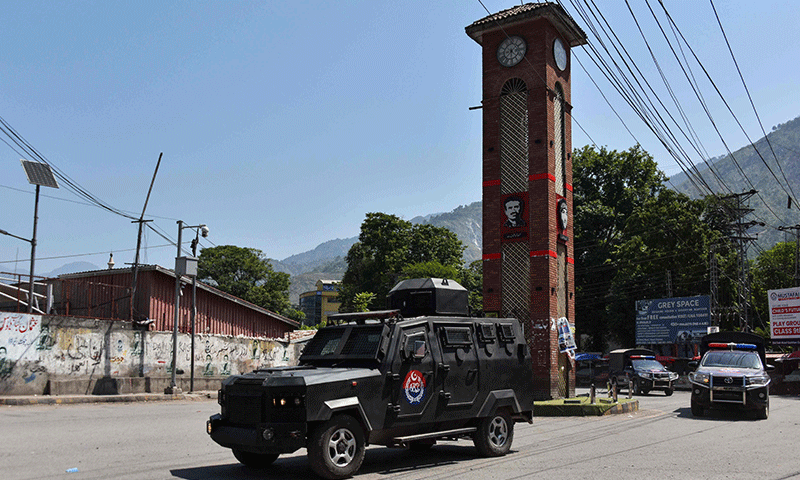
Monday’s proceedings again saw elaborate security arrangements, with heavy presence of undercover security personnel. Special passes were issued to the media.
“The learned counsel from both the sides addressed lengthy arguments on the issue of placing the matter before the full court and also cited a large number of judgments,” the short order said, adding: “In view of the admitted fact that the present cases involve unprecedented important constitutional and legal issues, let the matter be placed before the full court except, for the obvious reasons, the judges who are members of the Supreme Judicial Council and Justice Sardar Mohammad Raza Khan, Judge, who has already expressed his inability to hear this case. The necessary orders, in this regard, may be solicited from the ACJ.
“Further proceedings before the SJC will, however, remain stayed till the hearing of the cases by the full court and the applications for interim relief shall be placed before the full court.”
The court atmosphere at the outset became tense when two lawyers supporting government’s point of view adopted what appeared to be an aggressive posture. One of them even accused the acting chief justice of demonstrating partiality by not forming a full court as was the dictum established under the 1998 Malik Asad Ali case and delisting his petition filed against the chief justice.
His tone prompted Justice Javed Buttar to caution him to be respectful towards the ACJ and asked him to bring a petition if he felt aggrieved with ACJ’s orders. “Do you want us to rise,” the judge asked, saying the court was not inclined to pass an order on a matter which was not before it.
“The ACJ is holding a court, you can go there to raise your grievance,” Justice Nasirul Mulk observed.
“Either you send me to jail or fix my petition,” the lawyer demanded and alleged that a sister of one of the judges of the bench was actively participating in demonstrations outside the Supreme Court and the wife of another judge was cousin of the wife of the chief justice, whereas the appointment of an ad hoc judge had already been challenged.
At one time, Justice Javed Buttar observed that he was getting a feeling that some people had come here with some kind of aspirations and requested all to assist in the administration of justice. The court, however, handled the situation tactfully by letting the lawyer to vent his steam by asking others not to disturb him.
Senior counsel Sharifuddin Pirzada, appearing on behalf of President Pervez Musharraf, through a freshly-instituted application asked for the constitution of a full court and explained what he meant was a bench comprising all the remaining 12 judges of a total of the existing 16 judges, except two ad hoc judges.
Cases like this were always decided by a full court since the Malik Asad Ali case had attained the status of a convention, Mr Pirzada said.
Justice Nasirul Mulk asked Mr Pirzada to explain whether the instant bench enjoyed the power to constitute a full court when the ACJ had already exercised his authority by forming the present bench.
Barrister Aitzaz Ahsan described the application of the respondents (president and government) as loaded with ‘mischief’ and requested the court to commence hearing of the petitions since it was a properly constituted bench.
Having opposed the constitution of the full court and having themselves asserted that it was the prerogative of the chief justice to form the full court, the respondents were now started expressing lack of confidence in this bench, he deplored.