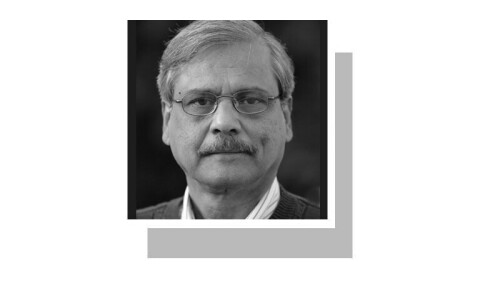
LAHORE, April 16: W.Z. Ahmed, 91, one of the most outstanding film directors of the subcontinent, passed away at a local hospital late on Sunday night. He was suffering from an infection of the lung. He was laid to rest at the Bagh-i-Rehmat graveyard on Monday afternoon.
After coming up with a series of films in only five years, Wahiduddin Ziauddin Ahmed, was not as prolific as some of his successors in the film industry. He directed-produced five films before the partition of the sub-continent: ‘Aik Raat’, ‘Mann Ki Jeet’, ‘Prem Sangeet’, ‘Prithaviraj- Samyukta’ and ‘Mira Bai’ — all released between 1942 and 1947.
After partition, he made just two films ‘Roohi’ and ‘Wada’, while a third one, ‘Wafa Ki Ada’, remained incomplete. The country’s environment was obviously not suited to his brand of cinema and his creation as one of his masterpieces, ‘Roohi’, has the distinction of being the first-ever film to be banned in Pakistan. The government said the film generated ‘class hatred’, and if that was not bad enough, portrayed a ‘rich married woman having an affair with a young, unmarried man’.
The ban was later revoked and ‘Roohi’ was released in 1954. The same year W.Z. Ahmed was at the forefront of the campaign against the screening of Indian films. The protest was known as ‘Jaal agitation’ after a Dev Anand-starrer of the same name that had been imported out of East Pakistan’s quota — a limited number of Indian films were allowed into Pakistan until then — and then brought over to West Pakistan. The protest led to the arrest of Mr Ahmed and many others in Lahore.
Mr Ahmed owned the Shalimar Pictures in Pune and another studio in Madras before 1947. Some very famous writers and lyricists worked for Shalimar, including Josh Malihabadi, Krisan Chander, Ramanand Sagar, Akhtar-ul-Iman and Sagar Nizami. He established the W.Z. Studio at Wahdat Road in Lahore after some years after partition. He spent many years of his life pursuing the ideal of a filmmakers’ cooperative.
Sanaullah Khan Gandapur, who worked as an assistant to W.Z. Ahmed, remembers his guru as an excellent story-writer and a director with a vision and skill to mould actors according to his requirement. “He was a man of diversified interests and immense knowledge,” Mr Gandapur says.
Mr Ahmed was born in Gujarat, India, in 1916 where his father was a senior police officer. He is said to have been moved into entering filmdom by K.L. Sehgal’s Dev Das. It is said Mr Ahmed went to watch Dev Das and was so disappointed with the production that he decided to direct films himself.
He married twice. His first wife was a daughter of Sir Ghulam Husain Hidayatullah. Later on, he married Shahida, who acted in films under the adopted name of Neena. She died a few years ago. Mr Ahmed had a son, Fariduddin Ahmed, and a daughter, Afia Rabbani.
Fariduddin Ahmed, well known as Farid Ahmed, was a talented filmmaker who married television and stage actor and producer, Samina Ahmed. Farid died in 1993.