0
0

WASHINGTON, March 1: Pakistan’s relations with the United States appear to be passing through a bad patch and experts believe that they could deteriorate further if the Taliban succeed in launching the much-talked about spring offensive.
“We could be heading towards a difficult period,” warns Dennis Kux, a former US ambassador and the author of several books on South Asia. “And it is not necessarily because Democrats now control Congress, you will have the same problem with Republicans. The re-mergence of Taliban is a major problem for both.” Paula R. Newberg, another South Asian expert, says: “The country that the US calls ‘our partner in the war on terror’ is having a tough year.”
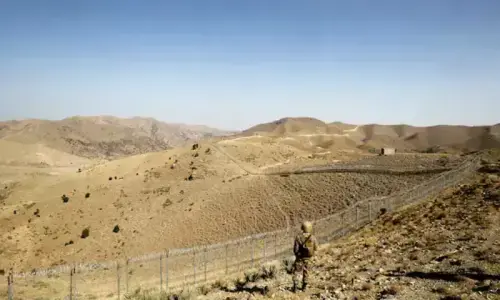
In an article for a Yale University publication, Yale Global, she notes: “Pakistan's mountainous tribal territories have returned to centre stage in the global fight against terrorism,” thanks to the re-emergence of the Taliban and Al Qaeda militants in that area.
“As Pakistan suffers through suicide bombings and sectarian discord, remaining on high terror alert, its ambitions remain surprisingly unclear,” she writes. “Pakistan's difficulties in reconciling the demands of its anti-terror allies with those of its own citizens raise critical questions about the viability of its regional ambitions and the durability of its ham-handed political system.”
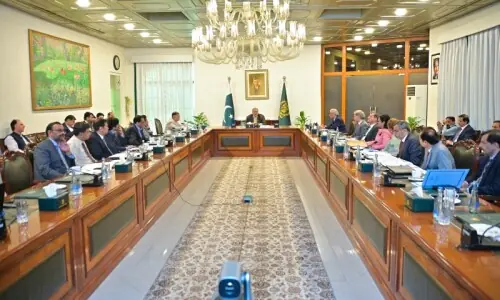
While commenting on Al Qaeda’s alleged resurgence in the tribal zone and Pakistan’s efforts to combat them, White House Press Secretary Tony Snow acknowledges that “these are very tough issues and you have to work through them (Pakistan) together.” The problems bedevilling US-Pakistan relations were further accentuated when US Vice President Dick Cheney arrived in Islamabad on Monday to discuss these issues. A senior US official, while briefing reporters travelling with Mr Cheney, said he had come with a ‘tough message’ for President Pervez Musharraf.
Later, the White House distributed a transcript of the official’s comments, containing a sentence which made it obvious who that senior administration official was. "The reason the president wanted me to come, obviously, is because of the continuing threat that exists in this part of the world on both sides of the Afghan-Pakistan border," the senior administration official was quoted as saying.
As the media noted this mistake, US Ambassador to Pakistan Ryan Crocker was called to the Foreign Office in Islamabad.
“In normal circumstances, we also call our friends, and yes we have called the US envoy,” said Foreign Secretary Riaz Mohammad Khan while explaining why the envoy was called.
The US media, however, reported on Thursday that Mr Crocker was brought in to ease US concerns about Pakistan's handling of extremists in their country.
A day after Mr Cheney visited Islamabad, America’s new intelligence chief Jack McConnell told the Senate Armed Services Committee that Osama bin Laden and his deputy were in Pakistan’s tribal territory; re-establishing Al Qaeda training camps.
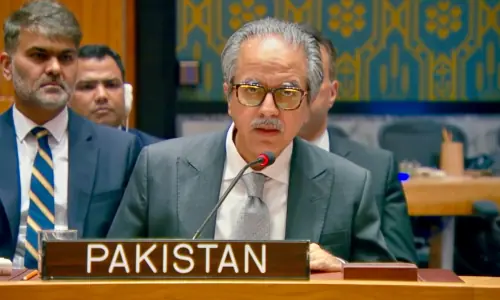
Statements like this forced Pakistan’s ambassador to Washington, Mahmud Ali Durrani, to concede that “everything is not hunky-dory” between Pakistan and the United States.
In a series of interviews to various US television channels, Ambassador Durrani complained that “too many things” were being asked of Pakistan and that the US administration did not seem to have enough belief in how Pakistan was pursuing terrorism.
He said those criticising Pakistan for not “doing more” were “keeping one eye shut and one open” by singling out Pakistan and saying nothing about what’s going on in Afghanistan.
Mr Kux, however, argues that the issue is not simply that of singling out Pakistan.
“People in Washington feel that either Pakistan did not do enough to fight the Taliban and Al Qaeda in the tribal zone or it does not have control over that area.
“This will be sad if it leads again to crisis in the relationship because both the US and Pakistan seem to have the same motive, which is fighting terrorism.”
The White House has indicated that Mr Cheney’s visit was aimed at preventing such a crisis and he appears to have succeeded in doing so.