0
0

RAWALPINDI, Feb 11: Millions of students across the country lack education about safety and natural hazards despite the fact that Pakistan has been ranked among the natural disaster- prone countries.
At present, teaching of disaster-related subjects is missing from textbooks in spite of the fact that children who are taught about natural hazard risks can play an important role in saving lives during disasters.
Stating that the calamity of the earthquake of October 2005 has resulted in a sudden realisation of the need for organised social behaviours during an emergency, a “white paper” on the national education policy prepared by the ministry of education admits that the country’s education system has not recognised the need for preparation of individuals and groups to grapple with the demands of emergencies through organised responses.
“The confusion and quandary resulting from unusual and abnormal physical and social turmoil has to be addressed in a calm, calculated and knowledgeable manner,” it says.
School education must prepare people for organised, ameliorative responses in such situations, it admits and recommends that curriculum for middle schools must formally address response in an emergency on the basis of latest experience worldwide.
“Since there is no firm commitment or time-frame on part of the government for developing the knowledge and technical tools on natural hazards and incorporating them into textbooks, it can be assumed that such an exercise is far from realisation.”
Hina and her daughter Neyha were among the victims of the Margalla Tower which collapsed during the October 8 earthquake. Brig (retired) Mohammad Amin of Rawalpindi formed an NGO in memory of his daughter Hina and granddaughter Neyha to increase public awareness about natural hazards and ways to cope with them. The number of high-rise and other buildings prone to earthquake poses serious problems that need to be tackled, says Brig Amin who formed Hands Pakistan.
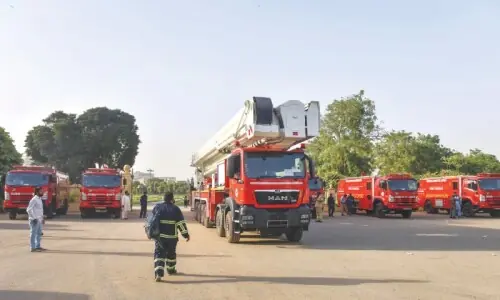
In his noble task, Brig Amin has been joined by another NGO, Kaus-i-Kazah of Multan, and the two NGOs have started free of cost training courses in Rawalpindi to build up a reserve of volunteers to cope with any future calamity. So far, 100 volunteers have been trained by professional trainers.
The training includes basic life support, principles and practice of first-aid, fire fighting, emergency management, basic trauma management, burn management, management of cardiac arrest, rescue and relief work.
The World Bank provided funds to the NGOs to carry out training programmes. The two NGOs plan to extend the training programmes to educational institutions in Rawalpindi and Islamabad.