0
0

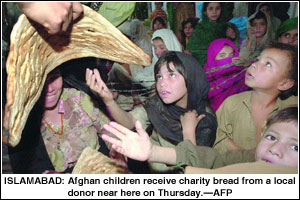 UNITED NATIONS, Oct 18: Differences between the United States and the UN officials have emerged over the future role of the world body in post-Taliban Afghanistan as they debate the tenuous situation in the country.
On Wednesday Secretary-General Kofi Annan’s Special Representative for Afghanistan Ambassador Lakhdar Brahimi said the United Nations was “not seeking” any role in peacekeeping, nation-building or a transitional government in the country.
Asked if the UN would be involved in a transitional administration or nation-building in Afghanistan, Mr Brahimi replied: “I very firmly say that the United Nations -and this is as a consequence of discussion with the Secretary-General this morning— is definitely not seeking anything of that sort.”
At the same time, the envoy said the UN would welcome the possibility of helping the Afghan people to re-construct their country. “We will definitely be doing as much as we can — that is a different thing from actually providing a direct administration for the country.”
US President George W. Bush wants the United Nations to take a leading role in helping Afghans form a new government, while Secretary of State Colin Powell said he thought there would probably be a “role for UN peacekeepers of some kind.”
US Secretary of State Colin Powell said on Monday the United Nations will be a key player in the transition from Taliban rule. “Clearly the United Nations will be playing a leading role. No one government will be able to handle it,” he said, adding that the best hope for future stability is a broad-based government.
But exactly “what Afghanistan might look like politically, economically diplomatically after the military phase ... is very much work in progress,” US Ambassador to the UN John Negroponte also observed.
However, Mr Brahimi urged the UN Security Council not to rush in with peacekeepers when the US-led military campaign ends.
“Afghanistan is a very difficult country,” cautioned Mr Brahimi, who is in charge of all UN operations in Afghanistan. “It’s a very proud people and they don’t like to be ordered around by foreigners. They don’t like to see foreigners there, especially in military uniforms.”
The former Algerian foreign minister made clear at a news conference Wednesday that he will be guided first and foremost by what the Afghan people want for their own future, then by neighbouring countries, and finally by interested governments like the United States.
Brahimi strongly indicated his own serious reservations about a major UN involvement in the mountainous central Asian nation, as well as those of Secretary-General Kofi Annan.
“What we are recommending is that the UN should never rush into sending a peace-keeping operation,” he said. “I would like to know what countries are rushing forward to offer troops.”
When asked why the United Nations shouldn’t send peacekeepers, he retorted: “I would like very much to know which countries are rushing forward to offer troops to mount a peace-keeping operation in Afghanistan.”
A Muslim-led force is another idea that’s been floated, but Brahimi said, “I don’t know why foreign Muslim troops would be more acceptable, to tell you the truth.”
The US administration hopes Afghanistan’s ruling Taliban militia, if it falls, will be replaced by a coalition built, perhaps, around the 87-year-old former King Mohammed Zahir Shah, who was overthrown in 1973.