0
0

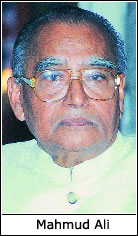 ISLAMABAD, Nov 17: Veteran Pakistan Movement leader and federal minister Mahmud Ali died on Friday in Lahore. He was 86. The octogenarian Bengali politician had remained committed to the cause of united Pakistan till the very last. He breathed his last while speaking at a children’s function at the Moonlight School near Hena Block. After addressing children for a few minutes, he slumped down on a chair He was rushed to the Punjab Institute of Cardiology where he was declared dead.
The late Mahmud Ali’s funeral prayer will be held at 11 am at the Faisal Masjid here.
Mahmud Ali was one of the two last links – Raja Tridiv Roy being another- with the former East Pakistan. At the time of the break-up of the country and creation of Bangladesh, Mr. Ali had made a conscious decision to settle in what had remained of Pakistan. In recognition of his decision, the then government of Zulfikar Ali Bhutto appointed him adviser to the president for political affairs. Later, he was appointed minister of state for national affairs. General Ziaul Haq elevated him to the status of full minister. Though he was never part of any cabinet, but successive governments kept his status as a minister in recognition of his sacrifices. Mahmud Ali was known for his passion for the two- nation theory and the unity of Pakistan, and would be best remembered for his contribution, along with that of his leader and party president Maulana Abdul Hameed Khan Bhashani, in the 1946 referendum following a campaign that Sylhet should join Pakistan. This campaign was crowned with success and the district, populated by a majority of Muslims, chose to join Pakistan.
Born on September 1, 1919, in a notable family of politicians and scholars of Sylhet, Mahmud Ali graduated from St. Edmund College, Shillong. In 1944, he became the first elected president of the Assam Muslim Students Federation. The same year he became a member of the Assam Provincial Muslim League working committee, acquiring in 1946 the important position of secretary-general of the provincial party.
He was then appointed a provincial minister in the former East Pakistan.
Mr. Mahmud Ali served in various periods as minister of national affairs, chairman of the Social Welfare Council, and adviser.
He made energetic efforts to secure international support for Pakistan during the turmoil of 1971, when the country was torn asunder. He was heart-broken at the separation. He was passionate in asking for the repatriation of stranded Pakistanis from Bangladesh, and also took a keen interest in the welfare of the Bengali-speaking people in Pakistan. He believed that Bengalis living at Karachi were bona fide citizens of Pakistan. It pained him to note that national identity cards and passports were being denied to these people.
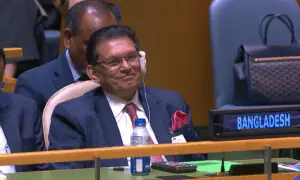
After leading the Pakistan delegation to the United Nations in
1971, where he learnt about the fall of East Pakistan on Dec. 16, 1971, he could not obviously return to Bangladesh and came to Islamabad with nothing but a suitcase and $300 in his pocket. Since then he had been living in Islamabad.
Mr. Mahmud Ali was also the founder of the Tehreek-i-Tekmeel Pakistan movement and through this forum he would go on appealing to the people to support the dream of making the Pakistan Resolution a reality, and eastern Bengal’s return to the fold. He also campaigned for a plebiscite in Kashmir. He also articulated this message in a monthly magazine, The Concept, of which he was founder editor.
He wrote two books, Quaid-i-Azam and Muslim Economic
Resurgence and What Should We Do Now.
The last named book deals with the dismissal of prime minister Khwaja Nazimuddin by governor-general Ghulam Muhammad and the subsequent dissolution of National Assembly in 1954. According to Mahmud Ali, this was a watershed year after which Pakistan slipped into undemocratic rule. He is survived by a son, four daughters, and a number of grandchildren. His wife Hajra died a few years ago.