



 0
0

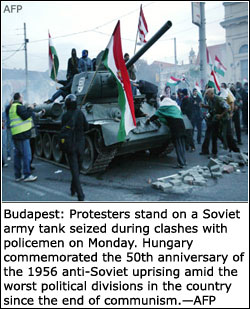 BUDAPEST, Oct 23: Hungarian police fired rubber bullets and teargas on Monday to disperse anti-government protesters marching on parliament on the 50th anniversary of the country’s uprising against Soviet rule.
The anniversary has been marred by a month of protests following the admission by Socialist Prime Minister Ferenc Gyurcsany in a leaked speech that he lied about the economy to win national elections in April.
Protesters seeking to march on a square outside parliament clashed with police after fighting earlier in the day led to 10 people arrested and several others injured.
“They are shooting rubber bullets at the protesters now,” a Reuters’ photographer said.
By late afternoon, police had pushed back protesters to Budapest’s central square, Deak Square, and continued to fire teargas, a witness said.
“Police are firing loads of teargas at about 1,000 protesters fighting them,” a Reuters’ reporter said.
Some protesters, their faces hidden behind scarves, lobbed stones at the police, a witness said.
But officers managed to force the protesters away from parliament square towards a major rally being held by the main right-of-centre Fidesz opposition party, which wants Gyurcsany to quit.
The possibility of further clashes earlier prompted the government to again close the square outside parliament, which had been due to host a public event celebrating the uprising, and to ask journalists not to go there.
Even before Gyurcsany’s leaked speech, many on the right questioned whether celebrations should be led by the Socialists, heirs to the communists whose rule was cemented for 33 more years after Soviet troops put down the uprising.
A government source said Gyurcsany would not attend the inauguration of a 1956 memorial this evening.
Some 2,600 Hungarians died battling Soviet troops, more than 200 were executed for their role in the uprising and 200,000 fled the country.
Hungarians are commemorating the 50th anniversary more divided than at any time since the collapse of communism in 1989.
Inside parliament, the prime minister said Hungarians in 1956 had no choice but to rebel, but the country, which held its first free elections in 1990 and joined the European Union in 2004, was now a modern, democratic state.
“Despite the often justified disappointment and discontent, the majority of Hungarians believe that parliamentary democracy is the most suited to express people’s will and to create law and give a programme to a free Hungary,” he said.—Reuters





























