0
0

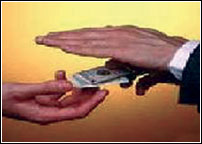 PETTY corruption in the form of bribery at the lowest levels in government departments costs Pakistanis approximately Rs45 billion annually.
In other words that is the price you pay at present for greasing your way out of thana and kutchery, taxation and customs departments, land administration and Railways, health and education and of course banks.
This is what the Transparency International (Pakistan Chapter) has found out from its latest survey (launched on August 8, 2006) on the extent of corruption at the lower levels in the government departments.
Not surprisingly, the TI (P) survey’s findings place police on the top of the corrupt heap, but the largest financial transactions have been found to take place through the customs department, followed by the land administration department and the judiciary.
The power sector is second on the list of corrupt government departments followed immediately by the judiciary. Next on the list is land administration, taxation, customs, health, education, Railways and government banks.
Among the four provinces, Punjab is slated as the most corrupt of all followed by Sindh, Balochistan and the NWFP.
Of the 4000 respondents 67.31 per cent believe the present military-led government is corrupt, followed by the Benazir’s second government (48 per cent), Nawaz Sharif’s second government (34 per cent). They ranked present government until the 2002 elections lower as only 32.69 per cent thought it was corrupt, followed by the first Nawaz government (10 per cent) and the first Benazir government( eight per cent).
The survey said, bribery or palm greasing has become so much part of the system that in all the 10 sectors, the demand is directly made by the officer or person involved, without the need of a negotiator or a middle man.
Bad governance in all the 10 government departments surveyed, combined with the public ignorance, impatient attitude and seeking short cut solutions by the consumers is believed to have aggravated the situation.
The three main reasons of corruption in view of the respondents were: lack of accountability, low salaries of the government employees and discretionary powers. The three measures suggested by the respondents for combating petty corruption were: accountability of public servants, adequate salaries and speedy judicial process.
This estimated cost of corruption (Rs45 billion) does not include the cost of corruption that is going on at the higher echelons in the form of commissions and omissions in the privatisation deals, defence and construction contracts, the stock market crashes, the hoarding and black marketing by sugar, cement, oil and automobile cartels or rip offs like the dubious Daimler Chrysler, Black cabs and Mercedes deals. If the costs of these corruptions are also taken into consideration the result perhaps would be too mind boggling.
Developing economies like Pakistan’s not only suffer from the twin menace of petty as well as higher echelon corruption, but these are also highly vulnerable to bribery being indulged in by the multinationals headquartered in the developed countries, although there does exist an OECD Anti-Bribery Convention.
According to an earlier survey (2002), conducted by the Germany based TI, multinational companies belonging to leading industrial countries like the US, Japan, Italy, Russia, China, Hong Kong, South Korea, Taiwan, Malaysia are pursuing a criminal course to win contracts in the leading emerging market economies of the world.
The TI had taken the position that politicians and public officials from the world’s leading industrial countries are ignoring the rot in their own backyards and the criminal bribe-paying activities of the multinational firms headquartered in their countries, while increasingly focusing on the high level of corruption in developing countries, “ the governments of the richest nations continue to fail to recognise the rampant undermining of fair global trade by bribe-paying multinational enterprises.”
The TI’s Bribe-Paying Index (BPI) had shown that US multinational corporations which have faced the risk of prosecution since 1977 under the Foreign Corrupt Practices Act have a high propensity to pay bribes to foreign government officials.
The US score of 5.3 out of best possible clean 10 was matched by Japanese companies and was worse than the scores for corporations from France, Spain, Germany, Singapore and the UK. The highest scores, indicating the lowest propensity to bribe abroad, were for companies from Australia, Sweden, Switzerland, Austria, Canada, the Netherlands and Belgium.
The BPI shows that the most flagrant corruption is seen in the public works/construction and arms and defence sectors, which are plagued by endemic bribery by foreign firms.
In a subsequent study by UK chapter of TI, it was estimated that foreign bribery was associated with tens of billions of dollars in defence deals. The other sectors in which multinational corporations were shown to have bribed their way to lucrative contracts include oil and gas, real estate, telecoms, power generation/transmission, mining, transportations and pharmaceuticals.
But this is not all. According to a paper delivered to an economic conference in the UK last week ( as reported in the Guardian of UK, September 4, 2006), Britain, the US and Switzerland should rank among the world’s most corrupt countries, “as the failure of these and other developed countries to clamp down on offshore tax havens is responsible for more hardship than any corrupt acts by third world leaders.”
The author of the paper, John Christensen, director of the Tax Justice Network speaking at the Economic Geography Research Group conference said:” I would place the United Kingdom on the list of most corrupt countries”. He said he based this on Britain’s role as a tax haven and a defender of the tax haven role of its overseas territories and Crown dependencies as well as its dismal role in undermining the effectiveness of the European Union’s attempts to close tax loopholes.
The German based TI is scheduled to launch a report on tax havens on October 4, 2006.
John Christensen further said that through a process of stealth, the global economy had been reconfigured to match the interests of a class of super-rich who held their wealth in offshore havens such as Jersey, Monaco, Switzerland or the Cayman Islands. “They live more or less where they choose, and their main pre-occupation lies in staying rich.”
He accused the key onshore actors notably Switzerland, the UK and the USA of acting to restrain efforts at achieving global cooperation in getting rid of their offshore tax havens.
Of course, one could not but agree with him that throughout the developing world ( including Pakistan) tax evasion and the looting of resources to secret bank accounts has nurtured resentment, widespread unemployment, poor public service and a general lack of opportunity.
And his suggested remedy for resolving this menace is also right on the dot as according to him, most of these problems can be resolved by strengthening international cooperation. Effective information exchange between national authorities would go a long way towards overcoming the problems of capital flight and tax evasion. The principal barrier standing in the way of progress towards achieving these goals according to him is the lack of political will.
Yes, of course, when the rich world collectively takes care of its tax havens, the destinations for sleaze money closes down and with that you are likely perhaps to catch the big fish wherever he is with his pockets bulging. And perhaps the trickle down effect would take of those with greasy pockets. And in the process the world economy as well as the national economies would be liberated from the retarding influence of corruption for good.