



 0
0

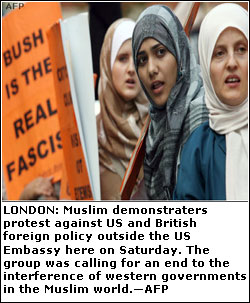 WASHINGTON, Aug 19: The US government’s support to totalitarian regimes in some Muslim countries is allowing terrorist groups to win sympathies of the people, says the latest congressional report on terrorism.
The report by the Congressional Research Service, which prepares policy papers for US lawmakers, acknowledges that there’s an obvious difference between the US administration’s declared objective of promoting democracy in the Islamic world and its practices.
Analysts who study Washington’s policies towards the Arab and Muslim worlds feel that ‘what the US government says does not match what it does’, the report notes.
The analysts feel that ‘US foreign policy is undermining efforts at US public diplomacy’ of winning over ‘hearts and minds’ of Muslim masses. “They cite the fact that the United States is strongly committed to promoting democracy and human rights, yet supports regimes in Pakistan, Saudi Arabia, and Egypt where arguably government respect for such values could be dramatically improved,” the report adds.
A growing number of analysts express concern that radical Islamist groups seek to exploit economic and political tensions in countries like Pakistan, Saudi Arabia, Egypt, Indonesia, Russia and Jordan.
“Because of their avowed goal of overthrowing secular or Western-allied regimes in certain countries with large Muslim populations, such groups are seen as a particular threat to US foreign policy objectives,” the report adds.
The report argues that international terrorism is increasingly becoming a threat to US foreign, as well as domestic, security. “Both timing and target selection by terrorists can affect US interests in areas ranging from preservation of commerce to nuclear non-proliferation to the Middle East peace process.”
The CRS also refers to the US State Department’s report on terrorism and notes that the report ‘tends to mute criticism of nations of strategic importance to the United States, such as Pakistan and Saudi Arabia, that arguably could do much more to curb terror.” Experts quoted in the CRS report are particularly concerned about the overall growth in numbers and political influence of radical Islamist political parties throughout the world.
“Some (of these parties) reportedly serve — or might serve — as fronts for terrorist activity,” the report warns. “Even if the parties are not actively serving as fronts … the actions and agendas of such groups could facilitate creation of a political climate in their home countries which views terrorism as a politically acceptable tactic,” the report adds.
It warns that the emergence of such groups might make their home countries appear as attractive locations for active terrorist groups to establish secure bases.
Some analysts, however, say that the participation of radical groups in politics might be a sign that these groups may be adopting channels other than violence to secure their base.
The report mentioned Pakistan, Indonesia and Malaysia among countries where radical Islamic groups are joining the political process. In the Middle East, Hamas and Hezbollah were named as radical groups that also won popular votes.
“Any rise in the power and influence of such terror-linked or terror-supportive political parties — especially should their representatives be elected through democratic processes — presents major policy dilemmas for the United States, since it pits US support for democracy directly against America’s commitment to aggressively combat terrorism,” the report adds.
The CRS warms against a resurgence of Taliban warlords and militia in southern and northern Afghanistan, noting that top Al Qaeda leaders Osama bin Laden and Ayman al Zawahiri, as well as the Taliban leader Mullah Mohammed Omar survived the US military operation in 2001 winter and remain at large.





























