0
0

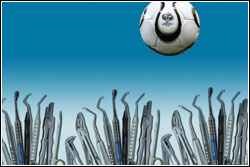 WITH more than a century-old manufacturing base, Sialkot represents an economy that is unique to the city. The city, whose manufacturing potential was first discovered by British colonialists towards the end of 19th century, produces exports goods like hand-stitched footballs and surgical instruments that no other city does. Its enterprising businessmen pride themselves in having created a niche for themselves in the global markets over the decades without any government help.
“In the last 27 years only one finance minister, that is, Shaukat Aziz, has ever visited this city, which chips in around $800 million to the national export earnings,” Ijaz Khokhar, who exports martial art wares around the world, complains. “This signifies the importance or the lack of it the government and its ministers attach to the city with largest share in the non-textile, non-agricultural export earnings of the country.”
Three major industries – sports goods (particularly footballs), surgical instruments, and leather garments, gloves and other goods – dominate the economy of Sialkot, which gained global fame when it produced tango balls for the FIFA World Cup 1982. Besides, there are several “hidden” industries like that musical instruments, which can grow in a big way provided the government decides to support them.
Located some 125km north-west of Lahore along the borders with India, some businessmen strongly feel the location of the city is one major factor in preventing every successive government from investing in the city’s industry in spite of recognition of its potential by the world.
Long before you enter Sialkot, you begin to feel the presence of a large and robust manufacturing base in the area. While the sight of workshops after workshops in and around the city with thousands of workers making more than 2,000 different surgical instruments and stitching leather garments and sports goods gives the feel of a city at work.
The newly constructed, modern corporate offices with facilities of luxury hotels on the suburbs of Sialkot show the strong links its exporters have created with their foreign buyers over the years.
Sialkot is also a city where you can see the real, “trickle down effect” of the cottage industry as is not evident anywhere else in the country, with an overwhelming majority of the 700,000 strong population working for the exporters under contracting and sub-contracting arrangements.
The entire industry of Sialkot, which boasts of highest per capita export earning and income, is spread horizontally, with men, women, boys and girls working in workshops as well as in their homes.
“Ours is a cottage industry, scattered across the length and breadth of the city as well as in the adjoining rural areas along the Daska, Sambrial, Wazirabad and Pasrur roads,” says Faisal Mahmood Khan, senior vice-president of the Sialkot Chamber of Commerce & Industry.
“We don’t work in a vacuum,” says Arif Mahmood Sheikh, who makes footballs. “First we secure orders from the foreign buyers and then begin to produce the goods by sub-contracting the job to workers in workshops and in their homes. It helps us save unnecessary overheads and stay competitive in the international markets.”
The horizontal spread of the manufacturing through contracting and sub-contracting arrangements has resulted in the proliferation of small and medium enterprises (SMEs) as well as trickling of wealth down to a considerably large portion of the population. But, at the same time, it precludes consolidation of the industry and thwarts the efforts of individual entrepreneurs to secure bank finance for capacity expansion and replacement of technology. “So far it has helped us grow. But now this sure is proving a major stumbling block in the forward movement of the industry,” confesses Khokhar and hastens to add: “It’s where the intervention of the government is required.”
After having experienced a strong boom in the sales during the last several years, exports from the city seem to be stagnated owing to several factors. Apart from factors like worsening law and order, there is lack of access to banking finance, absence of modern professional management and skilled labour, high wages, and rising cost of utilities, freight and inputs afflicting the SMEs around Punjab.
The industrial growth in Sialkot is adversely constrained by the manufacturers’ lack of access to modern technology and traditional way of production, their failure to innovate, improve the quality of their products and adopt to changing market demands.
The government’s utter failure to intervene and assist manufacturers to innovate, improve and become competitive in the global markets has also proved to be major snag in the further growth of exports from the city.
“Whatever we have achieved so far is actually attained on a self-help basis. The government has never invested anything for providing us the infrastructure to help the industry grow nor ever supported us through its policies. True, we are not as big as the textile industry, but we produce and export products like hand-stitched footballs and surgical instruments that are unique to this city.
Now, we are facing a strong challenge from China and other nations with modern technology and lower cost of production and doing business. If we don’t modernise urgently and reduce our cost of doing business, we will sure lose international markets to our competitors.
Our footballs are already losing their edge because of the introduction of mechanized balls by Thailand. The racket and stick industry has already been eliminated. We need resources for modernisation and replacement of technology to save our football, surgical and other sectors. And that can be done only with the help of the government,” insists Faisal.
Sialkot is the only city where the business community has contributed a good deal from its own earnings on the development of road and other infrastructure like airport (under completion), dry port, sewerage and what not.
“We are still continuing to invest in the development of the city,” says Faisal. In view of ongoing power load-shedding and breakdowns, businessmen are working on a plan to set up a thermal unit in public-private partnership mode for ensuring uninterrupted supply of electricity to the city. In addition to it, they are collaborating with Smeda for establishing modern testing laboratories where they will also develop new materials for their products.
But this commendable action has cost the business a lot. “If you ask me I’d say that whatever we are spending on infrastructure increases our cost of doing business. It is an extra burden on exporters.
Sitting quite far away from the port, our freight cost is already very high, and now we have to shoulder this responsibility of creating a modern infrastructure in our city as well for ourselves,” says Khokhar. “It is the responsibility of the government to ensure that the people and the industry are provided with these facilities.”
“We are like orphans. Nobody asks us as to what do we need,” says Arif Sheikh. “The government expects us to solve all our issues on our own without seeking any assistance from it. It is bad for the industry.
Instead of rewarding us for our good deeds, it (the government) is punishing us by looking the other way when we direly need its intervention to sustain our growth and increase our exports. If they can support textile and footwear why cannot they help us? Who needs six per cent R&D more than us?,” he asks.
“The dilemma of our city is that its true potential has not been realised at all. There has been little or no growth in production capacities. It is regrettable that this important city has been ignored by the government. There is nothing for the industries of Sialkot in the budget or in the trade policy for the current financial year,” says Naeem Anwar Qureishi, who exports surgical instruments.
Qureishi admits that the businesses had failed to innovate, improve the quality, and develop new products. But, he adds, “such an initiative required governmental support. The individual exporter or businessman does not have the resources for undertaking research & development (R&D) nor the time. The size of business does not allow such a venture.
Here is the space for the government to fill in by supporting our endeavours. If the government helps us, we can double our exports in no time. But if the government does not act now, the entire industry of Sialkot will go down the drain.”
Arif Sheikh says the government should help the industry, bring in new technology and prepare it for the competition. “It’s high time that the government stops step-motherly treatment meted out to us.”
However, the government agencies have a different point of view. “Exporters of Sialkot think that they have the saturation point and are no longer willing to expand, invest in technology, and R&D.
They can boost their exports in a big way provided they are willing to innovate and change their products according to the changing demands of the buyers. Had they adopted to the changing market demand and started using new materials, their racket and sticks industry would not have been eliminated. It still would have been thriving. They’ll have to become competent and find the markets for themselves. Unless they do so they won’t progress. They must understand that governments are mostly inefficient,” says a senior official of Smeda.
The sooner Sialkot understands this fact the better for its growth.