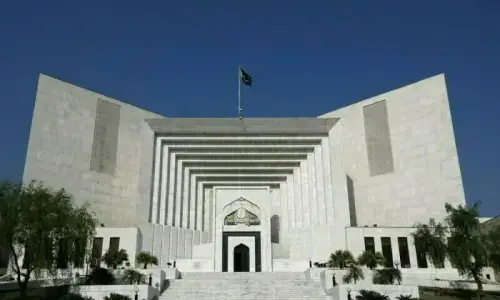
ON Nov 3 this year, Aitchison College, Lahore, will celebrate its 140th birthday. It has outlived the former Indian Civil Service which lasted 87 years (1858-1947), and is almost twice the age of the ICS’ successor, the Pakistan Civil Service.
In many ways, the path and purpose of Aitchison College have run parallel to both, in that it has produced generations of pre- and post-independence leadership.
At the time of independence, in August 1947, there were 980 ICS officers. They comprised 468 British and 512 Indian locals. Of the latter, 352 were Hindus and 101 Muslims. The remainder were a smattering of other faiths. The first Indian to be admitted to the ICS was Satyendranath Tagore, in 1863.
Until the 1950s, the ICS remained a misogynist preserve, as Aitchison College is even today. The first woman to be admitted into the Indian Administrative Service (IAS) was Anna Rajam Malhotra, who joined its 1951 batch. Initially, the Union Public Service Commission Board after her viva voce interview tried to discourage her from joining the IAS. It offered her the Foreign Service and Central Services, because these were ‘more suitable for women’. She resisted their blandishments, and in time rose in her career to become India’s first secretary.
Between 1950 and 2020, out of 11,569 officers who entered the IAS, only 1,527 (roughly 13 per cent) were women. The gender imbalance has been corrected since. The 2024 batch contained 41pc women.
That is lower than the counterpart representation in Pakistan’s civil service where, out of 217 fresh entrants into the 54th Common Training Programme (2026), 117 were men and almost half (100) women. Some of them will rise (male prejudice notwithstanding) to become secretaries in the federal government, as once the brave and unsung Miss Gulzar Bano had done.
In November 1947, Miss Gulzar Bano and her nine younger siblings travelled without their parents from Lucknow to Lahore. All she carried with her was a slip of paper containing the address of a relative living in Model Town. She studied with diligence, often attending school on alternate days as she and her sister had to share the same pair of shoes. In 1950, she sat for the CSS examination, topping the list of successful candidates. After the viva voce, however, the selection board relegated her to the second position because “it lacked confidence in women’s talents”.
She suffered a second humiliation when she discovered that she could not join the ‘serious’ services — the CSP, Foreign Service, or the Police. She had to join the Audit and Accounts Service. She reported to the accountant general (Post and Telegraph), who arranged for her desk to be placed in the public hall near the superintendent (her junior). The office had no toilet for ladies. On occasions, she was forced “to take a tonga to Government College” to relieve herself.
She reached the top of the bureaucracy’s greasy pole when she became cabinet secretary for a brief period, from June 4 to Dec 14, 1978. She described her 30-year career as a “kind of loneliness which only a single Pakistani woman starting work in the 1950s” could understand.
Ms Bano would have been gratified to learn that her example has inspired many women. Ms Tehmina Janjua, for one. In February 2017, she became our first female foreign secretary.
Such gender calibration suggests there is hope, were it not for the dismal results of the civil service exams. The results of the CSS 2026 written exam provide grim reading. Out of 17,351 candidates who appeared, only 476 candidates qualified, with a pass rate of 2.7pc. (Incidentally, 239 were men and 237 women.) For details of their results, one is referred by the Federal Public Service Commission to its results portal. Access it, and you will get this message: “No active information available in this section.”The FPSC has itself become a role model of institutionalised inertia.
Aspirants to our civil service undoubtedly study hard, pore over articles, digest numerous books, and plough through exam guides. But obviously, that is not enough. They may read everything, yet they learn nothing.
Had they been Chinese, they would have had to memorise between 50,000 to 100,000 characters. As it is, some of our senior civil servants, aspiring to be promoted to the level of federal secretaries, have found difficulty in mastering even 26 letters in the English alphabet. Some still think the title of the founder of our nation is ‘Quad-e-Azam’ or ‘Quid-e-Azam’.
One is reminded of the senior student at Aitchison College who concluded his recitation of a story once with the innovative word: ‘Theend’.
From such seeds…
The writer is an author.
Published in Dawn, October 29th, 2026