At UNGA debate, Pakistan warns against adding more members to Security Council, extending veto privileges
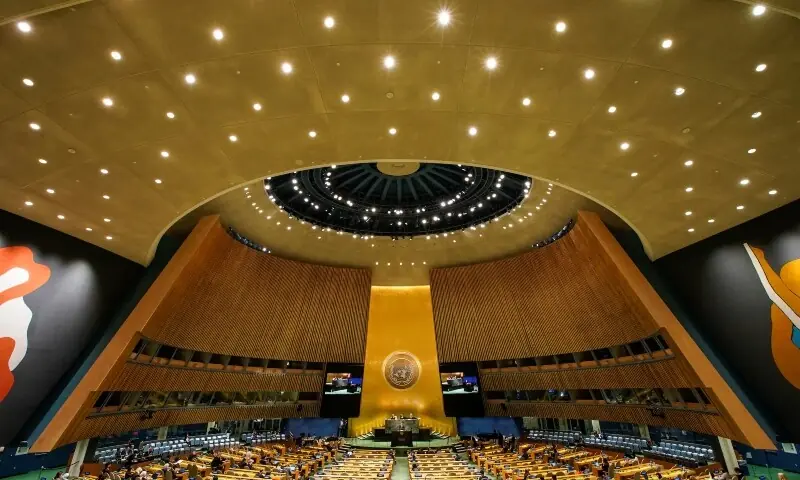
Pakistan has warned that adding more permanent members to the United Nations Security Council (UNSC) and extending veto privileges would “deepen existing inequalities, perpetuate historical advantages and increase the risk of Council paralysis”.
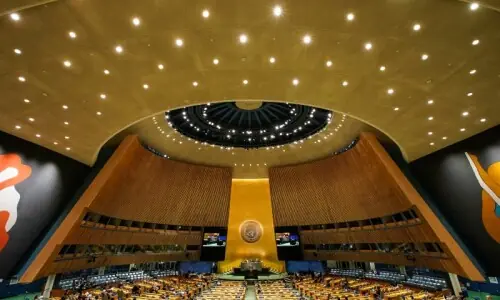
The counsellor at the Pakistan Mission at UN, Gul Qaiser Sarwani, presented these views at the UN General Assembly during a debate on the use of the veto.
He said Pakistan called for “comprehensive, democratic and equitable reform of the UN Security Council” and stressed that the misuse of veto power undermined UNSC’s effectiveness, weakened the credibility of the UN and perpetuated inequalities within the international system.
“Strategic rivalries and narrow interests among the Council’s permanent members had repeatedly impeded collective action on international peace and security,” he said, emphasising the “unique legitimacy” of the UNGA, whose universal membership and democratic decision-making enabled it to respond when the UNSC unable to act, including due to the exercise of the veto.
The Pakistani delegate opposed the creation of any new permanent seats in an expanded Security Council.
On proposals to regulate the use of the veto, he said Pakistan favoured its abolition or, at a minimum, severe restrictions on its use. He emphasised that the veto must not be expanded and reaffirmed Pakistan’s support for General Assembly resolution 76/262, which provides for a UNGA debate following the exercise of a veto to promote greater accountability.
Sarwani stressed that any measures to restrain the veto must remain consistent with the UN Charter. He called for a balanced approach combining restrictions on veto use with enhanced representation and a stronger role for elected members of the UNSC, making its decision-making “more democratic and providing an effective check on the exercise of veto power”.
The delegate further emphasised that the question of the veto must be addressed alongside the other four interrelated clusters under the Intergovernmental Negotiations on Security Council reform, as part of a comprehensive reform package.
Concluding his remarks, he reiterated “Pakistan’s strong commitment to reform that corrects existing imbalances, strengthens accountability and serves the collective interests of the entire UN membership rather than a select few”.
“Reform for all. Privilege for None!” he said.
A recent UN report has also warned that the veto power of the five permanent members of the Security Council is one of the reasons multilateral mechanisms have been unable to prevent or stop the growing number of state-based conflicts.
The resulting paralysis has weakened decision-making processes, prompting the UN secretary general to call for Security Council reforms, including an expansion of its membership to ensure fairer representation, particularly for Africa, Latin America and the Caribbean, and the Asia-Pacific region, it says.
“All these voices are underrepresented despite bearing much of the burden of peacemaking in an increasingly multipolar world,” the ‘World Social Report 2026’ notes.