Mining, blasting near Swat tunnel, gas pipeline alarm heritage experts
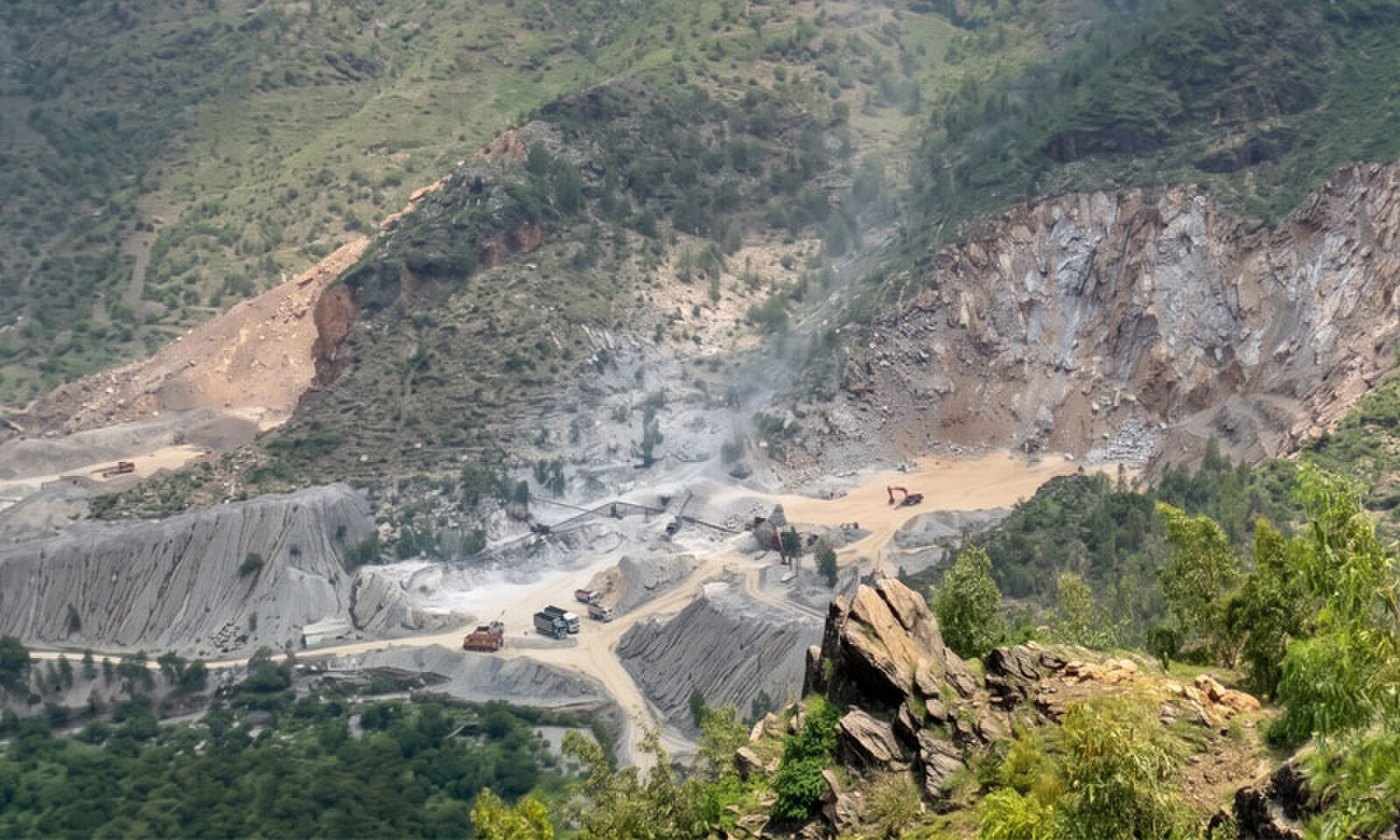
SWAT: Civil society activists and archaeologists have raised the alarm over mining, blasting and stone-crushing activity near the Swat Motorway tunnel, a branch of the ancient Elephant Road crossing the Shahkot Pass and the main gas pipeline serving Malakand Division.
The archaeology department had informed the deputy commissioner of Malakand about the issue last August.
The ancient road network crossing the Shahkot Pass is believed to be around 2,000- year-old, with its origins traced to the Buddhist period. It is also central to Yusufzai history.
It was through this pass that the Yusufzai Pashtuns, led by Malik Ahmad Khan, arrived in Swat in the early 16th century. The pass was successfully defended by the people of Thana and Aladand during the famous Raniai wars in the mid-19th century.
Department had informed DC about issue last August
As a result, the British were pushed back to Malakand where they had to build a longer and higher mountain road.
The ancient road near Shahkot, whose branches are clearly visible from the Swat Motorway on the Palai side, was so wide and well-built that it became known as the “Elephant Road” or Hathi-lar. Local historian Akbar Khan has described it as an important heritage site in the region.
Recent research has highlighted the area’s importance. The Khyber Path project, run by the Italian Archaeological Mission in collaboration with Ca’ Foscari University of Venice and the Khyber Pakhtunkhwa Directorate General of Archaeology and Museums, with funding from the Italian Agency for Development Cooperation (AICS), has found that the alamkot-Hathidara monument is part of a larger, previously unidentified fortified city. Dawn reported the findings in November 2025.
Project director Prof Luca Maria Olivieri said the stone-paved Hathi-lar road was a key stretch of the Uttarapatha, the great northern highway of the subcontinent. It linked eastern Gandhara with Swat, Bajaur, Kunar and Nangarhar. Researchers say it is the only surviving stretch of that highway in the region.
The excavations also uncovered the podium of a major Brahmanic temple dating to the late Shahi period. Archaeologists recovered dozens of sculpted stone blocks, some weighing up to 250kg. After documentation, these significant artefacts were moved to the Swat Museum for future display.
Surrounded by a continuous defensive wall with bastions and gates, the site also contains a stepped water tank, a masonry well, natural springs and ancient quarries. It was a fortified city named Jayapalanagara.
Historical sources report that the city housed a mosque, believed to be the earliest in KP, built during the Ghaznavid period on the orders of the Emir of Tus, about 20 years before the celebrated Ghaznavid mosque of Udegram in Swat.
Excavations are expected to continue into 2026 and 2027 in the hope of finding the mosque mentioned in a local bilingual Persian-Sanskrit inscription dating to the early 11th century, which was recently republished in the ISMEO journal East and West.
Director general (archaeology and museums) Dr Abdul Samad described the complex as one of the most important remains of the Hindu Shahi period. He said it was situated on a mountain pass that once connected Uddiyana with Gandhara.
Activists say daily heavy blasting to cut rock poses the greatest danger because the quarrying sites are very close to the Swat Motorway’s longest tunnel.
“Soon there will be cracks in the tunnels,” warned Nasir Khan.
People also complained that the vibrations could damage or rupture the SNGPL pipeline supplying the entire Malakand Division and if that happened, gas supplies to the whole division would be cut off.
The complaints come as authorities and international partners promote the area for heritage tourism.
The Khyber Path (Professions for Climate Adaptation, Eco-Tourism and Heritage) project plans to establish a 125km tourism trail along the Swat Motorway.
It will connect sites from Butkara to Barikot, Gumbat Balo Khale, Alamkot and Hathi-lar, extending down to Palai and up to Asota and Taxila. The project is expected to create jobs and promote responsible tourism.
Mr Nasir described Hathidara as one of the most significant archaeological sites in Malakand district. He said it had long been neglected and that many artefacts had been lost to illegal digging.
Activists and archaeologists urged the government to immediately stop mining and stone-crushing activities to protect the heritage site and the vital infrastructure nearby.
When contacted, Malakand commissioner Iqbal Hussain promised immediate action over dangerous mining and blasting activities and said he had already directed the deputy commissioner to take the necessary steps to address the threat.
Published in Dawn, October 24th, 2026