



 0
0

 THOUGH, agriculture is the main stay of Pakistan’s economy but major crops, accounting 35.2 per cent of the value-added declined by 3.6 per cent in 2005-06, while minor by 1.6 per cent.
The share of major crops to the Gross Domestic Product (GDP) fell from 23.4 per cent in 1970 to 7.6 per cent in 2005-06, and of minor from 4.2 per cent to 2.7 per cent. This reflects inept crop management policies of the successive governments dominated by the politically-influential feudal lords, industrialists, politicians and bureaucracy.
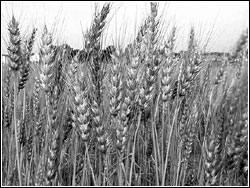
Wheat, the main staple food crop occupies nearly 37 per cent of the total cultivated area of 22.15 million hectares and contributes 13.7 per cent of the value-added and three per cent to the GDP.
According to the Pakistan Economic Survey 2005-06, wheat production during 2004-05 was 21.6 million tons. The carry-over stock till April 1, 2006 was 2.3 million tons. Thus the country had a surplus after meeting the domestic requirements of 22 million tons. Why then wheat worth $92 million was imported from July 2005 to March 2006?
Similarly, wheat production was 21.7 million tons during 2005-06 with a carry-over stock of 2.1 million tons with an exportable surplus of 1.8 million tons after meeting the domestic requirement. Why then the price of 100kg wheat bag has increased from Rs1,065 to Rs1,130 by the middle of July this year despite the availability of 6.55 million tons with the public sector and Passco.
The government was forced to ask the provinces and PASSCO to release the stock during July instead of its normal release in September. If this situation continues then the wheat and flour prices may increase by the next harvest during March–April in Sindh and April-May in Punjab. The common man and a large number of growers will ultimately suffer.
The goweres had to sell their wheat at much lower price than the government support price due to the non-supply of gunny bags on time by the concerned government officials. These bags are supplied to wheat traders and flour mill owners who purchase and hoard the commodity and take advantage by artificially creating its deficiency.
The situation is further compounded by the continued smuggling of wheat by the politically influential people across our porous western borders. For the last couple of years’ wheat trade had come under the control of feudal lords who, with the connivance of concerned bureaucracy are creating wheat and flour scarcity and earn commissions on its imports. This is just one example of poor crop mismanagement policies.
Rice is another important food and cash crop. Its share is 6.1 per cent of the total value-added in agriculture and contributes 1.3 per cent to the GDP.
Although it occupies nearly 12 per cent of the total cultivated area, its export earning was $835 million from July 2005 to March 2006 as against $625 million earned during the same period of last year.
Rice is the second largest export earning crop after cotton and its textile bye-products. The major source of rice export earning is fine Basmati rice grown exclusively in the rice belt of Punjab.
After 1947, only coarse rice was grown in the Indian Punjab which could not compete with the fine Basmati rice of Pakistan in the international market. Therefore, India managed to smuggle it at higher prices through our eastern borders, especially through Sialkot. It then exported it to international rice market as the Indian Basmati at a relatively cheaper rate than the Pakistani Basmati to capture the international market. Later on, they smuggled the seed of our fine rice and grew and multiplied it in India. Now they are not only exporting it but are also registering it as the Indian Basmati.
Some scribes, who visited the agricultural universities and research institutes of the Indian Punjab, Karnal, Hassar and New Dehli in 80s came to know about the aforementioned Indian plan and reported the matter to the then government of Pakistan. The senior scribe warned again and again to the successive governments about this situation and its future impact on our fine basmati rice trade but without any effect.
As a result, first an American Trade Corporation registered Basmati fine rice in its name a few years ago and now India has registered our super Basmati, thus causing problems for Pakistani rice exporters.
However, our government has taken up this issue with the Indian government which has offered to register super Basmati as joint geographical indication, while there is not a single example of joint geographical indication by two countries under the WTO.
Had timely action been taken as proposed by the scribes in 80s and later, there would not have been the present controversy between Pakistan and India. This again reflects on the inept policies of our agricultural managers.
The country produced 5.5 million tons of rice during 2005-06 but due to the 40 per cent duty by the Iranian government on the import of Pakistan’s super kernel rice, it is now being smuggled in large quantities to the Iranian markets on much cheaper prices, causing huge export losses.
The scientists of the Ayub Agricultural Institute, Faisalabad claimed to have developed a new sugarcane variety the HSF242 with 13 per cent sugar recovery and high yielding potential which is above the national and international average cane yield.
Unless the government can persuade sugar mill owners to change their policy of cane pricing on the basis of sugar recovery percentage rather cane weight, the new variety may go waste. A similar high sugarcane variety with 12 per cent recovery was also developed by the same institute decades ago but in absence of price fixing on sugar recovery basis, its potential could not be exploited.
The Ayub Agricultural Research Institute scientists further developed bed-furrow planting technique for sugarcane. It reduces water requirements by 50 per cent without effecting the plant population and yield. For example, the area under sugarcane declined from 11,00,000 hectares in 2002-03 to 9,07,000 in 2005-06 due to the declining water resource and shift to other crops due to problems such as the non-payment of dues, under weighing of cane, exploitation by middlemen, and etc.
The water requirements of annual sugarcane crop at root zone is 64 acre-inch, while that of perennial crop grown on fairly large areas especially in Sindh and the NWFP is 80-100 acre-inch and an additional water up to 40 per cent is required due to its wastage in the existing canal irrigation system and watercourses and poor land leveling. By following the bed-furrow technology, a significant amount of water could be saved.
Similarly, cotton is not only export earning crop but it also provides raw material to the local textile industries. It accounts for 8.6 per cent of the value-added in agriculture and about 1.9 per cent to the GDP. Production this year was about 13 per cent lower. It was blamed on the unfavourable cotton growing season instead of poor cop management.
Major oilseed crops include cottonseed, rapeseed/mustard, canola, sunflower etc. Despite various projects to increase oilseed production, the country is still importing edible oil thus increasing the import bill. This again reflects on poor crop management by the policy makers who are more interested in earning commissions rather than making the country self- sufficient in food grains.
The country may face serious problems of importing palm oil at higher prices in the near future as both Malaysia and Indonesia have started converting 40 per cent of their total palm oil production for making ethnol due to highly increasing cost of petrol in the international market.
The production of pulses like gram, masoor, moong and mash has declined by 39.3, 13.5, 12.6 and 9.8 per cent, respectively during 2005-06. Their prices like those of wheat, sugar, edible oil, etc., have also increased significantly. Their import may further increase the trade deficit which was has already hit $12.1 billion against the earlier estimate of $9.4 billion.
The major reasons of low crop yields are declining land resource base due to water logging, salinity and continued fragmentation of farm land which has increased small, subsistent and below subsistent level farms, adversely affecting their productivity; decreasing surface and groundwater resources and their theft by feudal lords; increasing high cost of inputs, their quality, untimely delivery, poor pest management, poor support price and marketing system; agricultural credit going to big landlords thus making common and small farmers cultivating major part of the total cropped area, the ultimate sufferers; and non-implementation of most of the agricultural development projects in real sense due corruption at various levels. These are just a few examples of flawed crop management policies.






























