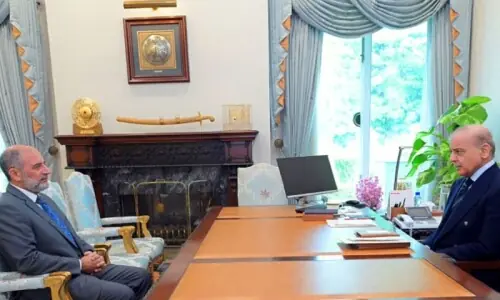
PTI carried out 'political suicide attack' on its own KP govt, says Bilawal
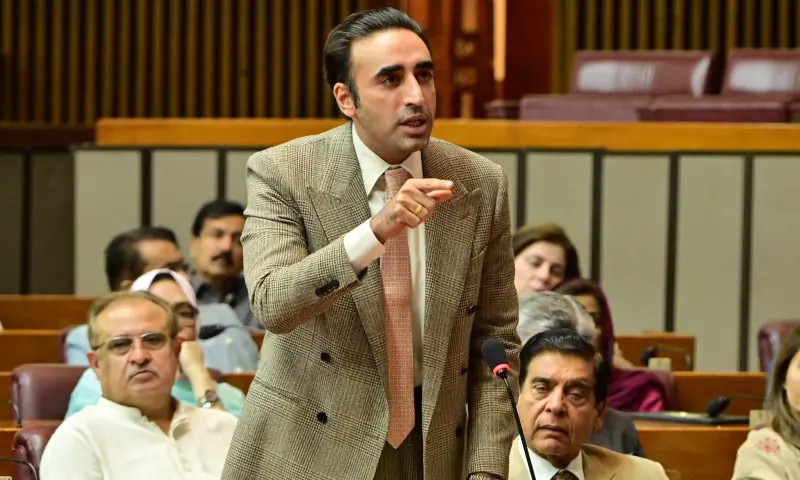
PPP Chairman Bilawal Bhutto-Zardari on Wednesday blamed the PTI’s Khyber Pakhtunkhwa government for the circumstances that led to the imposition of emergency in the province, terming it a “political suicide attack”.
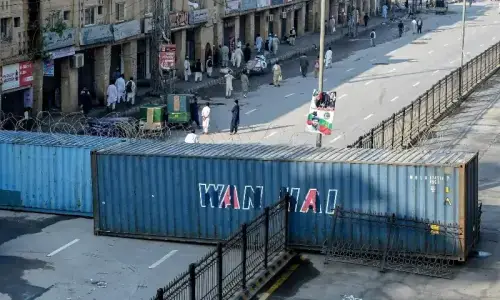
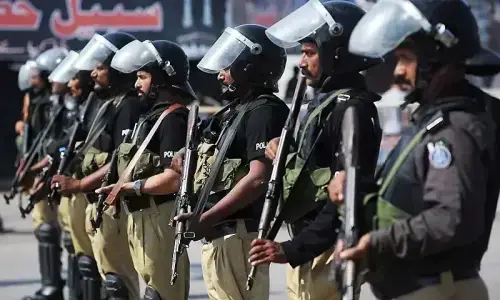
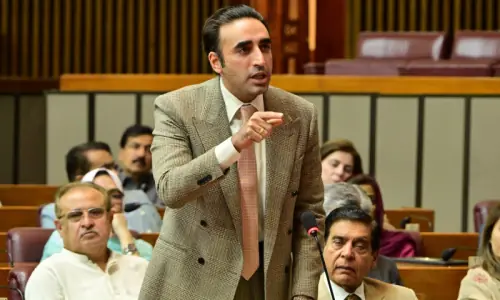
He made the remarks while addressing the National Assembly, which is discussing the Centre’s measures of imposing emergency and governor’s rule in KP, for which it cited the provincial government’s “deliberate disengagement” from the fight against terrorism.
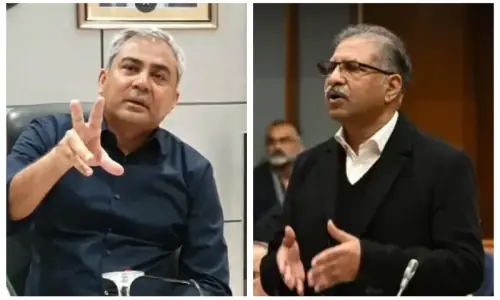
The NA question hour session was suspended due to discussions on the emergency. Minister for Parliamentary Affairs Tariq Fazal Chaudhry tabled the motion regarding the proclamation of emergency, while Law Minister Azam Nazeer Tarar opened the discussion.
At the outset of the proceedings, opposition members were sitting calmly and staging no protest.
Bilawal began his speech by highlighting that emergency and governor’s rule in KP were measures taken under the Constitution.
Reading the relevant provisions, Bilawal asserted that the Centre tried its best to “engage the opposition so this step does not have to be taken”.
“They will have to accept, even if not publicly, but the responsible leadership of the opposition knows that the PTI itself carried out a political suicide attack on its KP government,” he remarked.
The PPP chief maintained that the PTI could not deny that its “leadership, particularly the provincial, had a key role in the political, constitutional and legal circumstances” present.
Bilawal emphasised that the PPP’s stance was that “before using this constitutional atomic bomb, we must engage with PTI and the opposition and have to try to address the federal government’s reservations that they were not supporting them in the war against terrorism”.
He observed: “If political space is restricted for one political party, it is impossible that the political space is restricted only for that political party; it is limited for every political party, political worker and Pakistani citizen.
“We are responsible for this, but you cannot deny that you are also responsible for it.”
Terming the imposition of emergency a “difficult decision”, Bilawal recalled alleged remarks by Sohail Afridi — the KP chief minister whose role is now non-functional — that he would not combat terrorism the way the Centre wanted.
“If this was not a political suicide, then what else was it?”
The Bhutto scion wondered if the opposition and the KP CM had left any reason that President Asif Ali Zardari, who prides himself on passing the 18th Amendment, could “refuse to sign” the emergency proclamation.
He argued that due to the PTI’s actions and statements, neither the president, the Centre, nor he had any legal or political reason left for not imposing emergency in KP.
“But even today, I would recommend to the federal government that we should extend our hand forward once again for negotiations, political discussions and to find a resolution and middle path,” Bilawal added.
The PPP chairman noted that emergency was “always a stopgap measure”.
“We cannot sustain the emergency forever,” he added, emphasising that while the counterterrorism fight would be better than before, an “all-of-society and all-of-country response” was still needed to eradicate terrorism completely.
Regarding the Oct 3 talks of a joint delegation of the PPP and the government with the opposition, Bilawal said, “Late at night, I was informed that congratulations, negotiations are succeeding.”
He said the PTI was willing to declare the areas in KP with surging terrorism as “terrorist areas”, and the opposition was about to agree that the federal and KP governments would sign a pact on joint efforts against terrorism. However, the dialogue collapsed.
The former foreign minister pointed out that the security challenges Pakistan was facing were “way more complicated” than before, adding that India “could still not digest […] its embarrassment” from the May 2025 conflict.
Referring to remarks by Indian Prime Minister Narendra Modi that its ‘Operation Sindoor’ was still ongoing, Bilawal said: “It means that India is still sponsoring terrorist incidents in Pakistan, sometimes in the form of TTP (Tehreek-i-Taliban Pakistan) and sometimes in the form of separatist terrorist groups.”
He reiterated Pakistan’s stance that India was involved in terrorist activities being conducted from across the Afghan border.
The ex-foreign minister then highlighted Islamabad’s role as a mediator in the US-Iran war.
“But there is a state — which we do not recognise as a state — that will neither be happy nor ever forget that you took this step. And those Zionist forces will and are interfering in Pakistan’s internal politics and state.”
Concluding his speech, the PPP chairman emphasised the need for building consensus on “some fundamental issues” for an empowered lower house.
“Even today, we are saying, come and at least begin from this house,” he said while addressing the opposition benches.
‘Threat to national security’
Addressing the house, Law Minister Azam Nazeer Tarar explained that emergency was imposed in KP as the security situation there was becoming a threat to “national security”.
Tarar noted that after the proclamation of emergency was issued, the Constitution’s Article 232 required that both houses of the parliament approve the measure.
He recalled that the federal cabinet examined “material” regarding terrorism in the province during its Oct 11 meeting and then advised Prime Minister Shehbaz Sharif to recommend the imposition of emergency.
He noted that some people compared the measure to the emergency imposed by former dictator Gen Pervez Musharraf on Oct 12, 1999.
The minister particularly noted “internal disturbances” and cross-border infiltrations. He contended that the situation since Oct 15, 2025, when Sohail Afridi’s government came into power in KP, was “turning into a threat to national security to an alarming extent”.
He went on to highlight that there was a rise in terrorism in KP, especially after 2021, due to the approach of the provincial government.
“Perhaps there might be foreign, diplomatic and political reasons behind it, which got inflamed due to a political party’s point of view.”
Tarar stated that 2,911 incidents of terrorism took place between 2021 and 2024 in KP, but they surged to 3,787 incidents between Oct 15, 2025 and Oct 9, 2026.
He criticised the KP chief minister for ignoring martyred security and police personnel, and for instead preferring to promote his political designs and make visits across the country.
“Even this was announced that the federal capital will be conquered,” he said, referring to the party’s plan to hold a protest long march towards the federal capital.
The PML-N leader expressed his government’s gratitude to NA Speaker Ayaz Sadiq for providing a platform for dialogue between the Centre and the opposition. He reiterated the government’s stance that the PTI had the agreement draft changed multiple times, but even then backed off from it.
Tarar observed that the PTI demanded the release of their party founder Imran Khan and his treatment in a private hospital despite knowing that only courts could provide such a relief.
He said two days would be “remembered in the country’s democratic history with regard to misfortune and a political party”.
On the emergency measure, the law minister noted that a special mechanism has been introduced for 12 districts of KP.
In his remarks on the NA floor, Opposition Leader Mehmood Khan Achakzai took aim at Tarar for trying to prove that terrorism was not tackled in KP.
He questioned the government’s mandate in the February 2024 general elections, quipping that the opposition would “surrender” if the minister could swear that the government won those polls fairly.
Achakzai alleged that the incumbent ruling coalition was formed “illegally”.