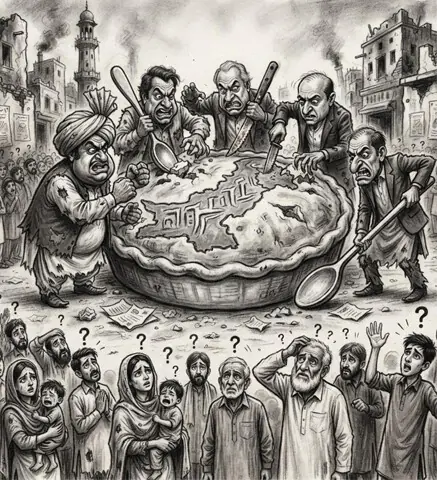
WHENEVER Pakistan confronts a crisis of governance, someone or the other presents the idea of creating new provinces as a remedy for administrative inefficiency, regional deprivation and political alienation, arguing that smaller provinces should mean governments closer to citizens, greater representation and more balanced development. However, the governance crisis in Pakistan is not fundamentally a problem of geography. It is a problem of power. The central question is not how many provinces the country should have, but how much authority ordinary citizens actually possess over the institutions that govern their daily lives.
The 18th Amendment transformed the federal structure by transferring substantial legislative, administrative and fiscal authority from Islamabad to the provinces. Yet, decentralisation largely stopped at provincial capitals. Islamabad surrendered power to Lahore, Karachi, Peshawar and Quetta, but the provincial capitals retained power over districts and municipalities. This is why the creation of additional provinces cannot automatically be equated with decentralisation.
Pakistan can simply replace the four powerful provincial capitals with several more. The map would change, but the citizen-state relationship would remain largely unaffected.
The actual test of federalism is what happens below the provincial level. Article 140A provides the constitutional foundation for local governments, requiring provinces to devolve political, administrative and financial responsibility and authority to elected local representatives. Yet, Pakistan’s third tier remains fiscally and institutionally constrained.
This imbalance has direct consequences. People do not come face-to-face with the National Finance Commission (NFC) or the Council of Common Interests (CCI). They encounter the municipal system — or its absence. The fiscal architecture re-inforces the problem. The provincial finance commissions (PFCs) have not enjoyed the same institutional protection as the NFC, leaving local governments dependent on provincial discretion. Where municipalities lack predictable transfers and independent revenue sources, they cannot sustainably plan infrastructure or deliver services. The result is a cycle in which political authority remains centralised, while responsibility for poor services becomes diffused.
Pakistan, therefore, faces a devolution paradox. Provinces understandably demand autonomy from the federation, but provincial governments remain reluctant when it comes to surrendering equivalent authority to the municipalities.
Members of provincial and national assemblies may also consider empowered mayors and local councils their compe- titors in terms of political influence and development resources. This creates an incentive structure under which decen- tralisation remains politically attractive in rhetoric, but very difficult to implement institutionally.
A serious governance reform agenda would begin by strengthening Article 140A. Local governments need predictable constitutional protection, regular elections and clearly defined responsibilities. PFCs should operate through transparent, formula-based mechanisms, with allocations reflecting not only population, but also poverty, infrastructure deficits and fiscal capacity. Municipalities should also possess meaningful own-source revenues, including authority over appropriate property taxation, licensing and user charges. The objective should be simple: move the point of decision-making as close as possible to the people affected by that decision.
Pakistan surely does not have to choose between federalism and local empowerment. A stronger local government system could actually make federalism more meaningful. The crisis is not that Pakistan has too few provinces. It is that too much government remains too far away from the citizens. Only genuine devolution can create a new relationship between the state and society. If Pakistan wants to repair its broken social contract, the most consequential boundary to redraw may not be the provincial boundary, but the actual boundary separating centra- lised authority and empowered citizens.
Airaaf Ali
Sukkur
Published in Dawn, October 14th, 2026