EXPLAINER-Makkah pact and defence of the Kingdom
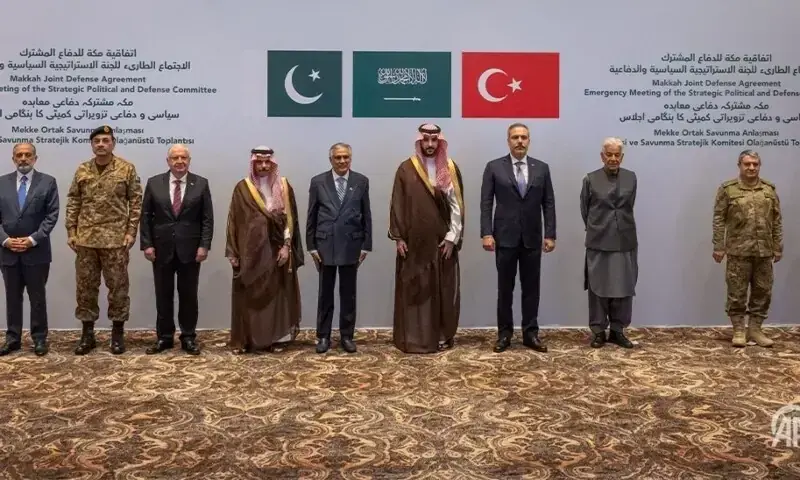
THE Makkah alliance has moved, in less than two months, from a political declaration towards practical cooperation, though it remains a few steps short of becoming a fully operational military alliance.
Its Strategic Political and Defence Committee, which met in Riyadh on Oct 5, decided “to move immediately to the practical implementation of the collective defence commitments”.
The operative part of the decision, however, is narrower than some of the headlines it has generated. The three countries agreed to “take the necessary measures to provide the agreed military forces and capabilities and ensure their rapid deployment in the Kingdom, in accordance with the approved arrangements and the national legislation of the Parties”.
The Saudi urgency to see the alliance working is understandable. Through September and into early October, Yemen’s Ansar Allah group, commonly known as the Houthis, fired missiles and drones towards southern Saudi cities and energy facilities, with Riyadh saying the attacks also targeted the holy cities. One such strike hit a power station in Madina supplying Masjid-i-Nabvi.
Progress so far includes political commitment, the appointment of an institutional head and formation of the Riyadh secretariat No public authorisation yet for Pakistani or Turkish forces to participate in combat inside Yemen; Turkiye only providing defensive and technical support so far
At the same time, the Aden-based Presidential Leadership Council announced a counteroffensive to reverse Ansar Allah gains along the Red Sea coast. Government forces, backed by coalition air support, claimed to have recaptured Mocha and positions near Bab al Mandeb, although those claims remain contested.
The Riyadh meeting and developments in Yemen came within a day of each other and are politically linked, even if they are not demonstrably part of the same operational plan. The committee’s statement, importantly, made no reference to Mocha, Bab al Mandeb or operations inside Yemen, and did not name the Houthis.
The alliance has nevertheless covered considerable ground since its inception on Aug 7. An inaugural summit was followed by a meeting of the Strategic and Political Committee in Istanbul at the end of August.
On Sept 25, the three countries’ military chiefs met in Riyadh and agreed to pursue intelligence sharing, military coordination and capability integration, though they made no mention of a joint command. On the sidelines, Pakistan’s Chief of Defence Forces and Chief of Army Staff Field Marshal Asim Munir and Saudi Defence Minister Prince Khalid bin Salman also discussed continuing “joint efforts” against attacks on the Kingdom.
The Oct 5 meeting took the next institutional steps, endorsing retired Lt Gen Nauman Mahmood as the alliance’s first secretary general, placing the Riyadh-based secretariat under his charge and authorising the rapid deployment of military forces and capabilities already “agreed”.
The progress so far includes a political commitment, an institutional head and secretariat, two committee meetings, a meeting of military chiefs and a decision to begin implementation.
What remains missing is a standing assigned force, a joint commander, publicly defined rules of engagement and a published military doctrine. There is also no public authorisation for Pakistani or Turkish forces to participate in combat operations inside Yemen.
In fact, Turkish officials told Reuters on Wednesday that Ankara was “sending mainly defensive and technical support to Saudi Arabia to help it fight the Houthis, adding that the support expected from Turkiye was only in the form of military equipment, intelligence sharing, and weapons systems, and that no other form of deployment had taken place as part of the alliance so far.
Between the lines
Understanding the alliance requires answers to basic questions that remain unresolved as to what constitutes a threat or an attack, against whom has the alliance been formed, what would trigger a response, and who would decide on action and through which command structure?
In the absence of a published charter and doctrine, its working principles have to be pieced together from the August agreement, subsequent government statements and the Oct 5 decision.
The threat, in the language used by the parties, is an armed attack on a member’s security, sovereignty or territorial integrity, with particular emphasis on protecting Makkah and Madinah. There is, however, no public definition covering attacks on forces, ships, diplomatic missions or personnel outside national territory. The Houthis are impliedly identified as the attackers, while Iran is widely seen as their enabling power, but neither is named in the agreement.
Collective deterrence appears to mean making the commitment credible through military readiness, coordination and the ability to respond. No punishment strategy has been published, while a response seems contingent on a request from the country under threat, agreement on the measures to be taken and compliance with each country’s national laws.
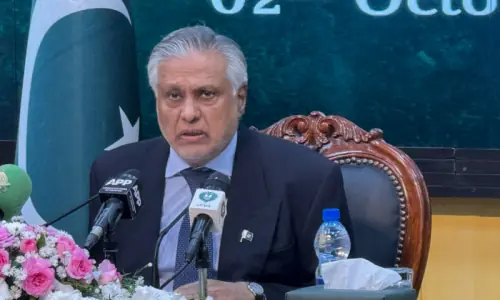
Pakistan’s Deputy Prime Minister and Foreign Minister Ishaq Dar has described the agreement as defensive, without an offensive agenda. Defence Minister Khawaja Asif has said Pakistani and Turkish forces would play a supporting role, including reconnaissance, while Saudi forces conduct combat operations.
The Oct 5 decision, which provides for deployment inside the Kingdom rather than a joint campaign, is consistent with this narrower interpretation. The capabilities under discussion, including air and missile defence, reconnaissance, intelligence, counter-drone systems and technical support, also point to a defensive design.
Great expectations
Yet the gap between the public positions of Pakistan and Türkiye, and Saudi expectations, is already visible. Prince Khalid said after the meeting that the committee had affirmed solidarity “in confronting the sinful aggressions that targeted the Kingdom and the Holy Sanctuaries, activating collective deterrence against these aggressions, and against all those standing behind them”.
The reference to Houthi attacks is clear enough, but “all those standing behind them” is a broader Saudi political signal absent from the joint statement and not further defined. Pakistan and Turkiye have maintained that the alliance is not directed against another country.
The three partners may not wish to emphasise their differing interests, but these are clear. Riyadh wants protection for its territory and greater pressure on those attacking it, whereas Pakistan wants to honour its commitment to Saudi Arabia without being drawn into another Yemen war or a confrontation with Iran and Türkiye seeks a larger regional security role but faces its own political and legal constraints. The agreement can accommodate these differences as long as its mission remains defensive.
Its language is carefully circumscribed as it refers to capabilities already “agreed”, rather than whatever forces Riyadh might request, and specifies deployment inside the Kingdom under national legislation. An Article 5 like commitment that still requires consultation, agreement and action under national law does not amount to an automatic military response.
Saudi Arabia can therefore expect defensive reinforcement on its territory, political backing and supporting capabilities for its existing campaign. It cannot yet treat the agreement as an automatic commitment to operations beyond its borders or as a joint military doctrine against unnamed states or groups backing the Houthis.
The reference to national legislation is particularly important. In Pakistan, a wider military role could revive debate over the unanimous parliamentary resolution of April 2015, which called for neutrality in the Yemen conflict while pledging that Pakistan would stand shoulder to shoulder with Saudi Arabia if its territorial integrity or the two Holy Mosques came under threat.
A deployment to defend Saudi territory and the holy sites, including the Pakistani presence already there, can be presented as consistent with that resolution. Participation in fighting around Mocha, however, would be much harder to reconcile with its language.
Any move beyond defensive deployment could therefore require fresh political authorisation, raising questions about how far the government could depart from the earlier parliamentary position.
Turkiye faces a different constraint as Article 92 of its constitution requires parliamentary approval for deploying troops abroad, and no such approval has been publicly reported. Equipment, technical teams and specialists can move faster than military units, allowing Ankara to contribute within a legal process different from Pakistan’s.
Previous pacts
The trilateral framework is also building on, rather than replacing, the existing Pakistan-Saudi military relationship. Under the 2025 Strategic Mutual Defence Agreement, Pakistani air and support elements were already deployed in the Kingdom.
This was possibly what Inter-Services Public Relations Director General Lieutenant General Ahmed Sharif Chaudhry meant when he recently told a CNN interviewer that Pakistani troops have been in the Kingdom “for decades”, and across multiple domains.
The understanding between Field Marshal Munir and Prince Khalid to continue cooperation against the attacks kept that bilateral channel active while aligning it more closely with the Makkah Alliance.
The additional capabilities envisaged under the Oct 5 decision are more likely to involve air defence, intelligence, reconnaissance and specialist support than a large Pakistani ground contingent for Yemen, which would sit uneasily with both the 2015 resolution and the government’s stated position.
The next test is how far implementation goes and whether additional Pakistani air defence or air assets are moved to Saudi Arabia, whether Turkish systems and specialists arrive, and whether the supporting role remains confined to Saudi territory. Any extension into fighting along the Red Sea coast would turn the difference between the agreed text and Riyadh’s wider interpretation of “all those standing behind them” into a substantive issue.
There is also a practical obstacle to an integrated defence alliance, which is that interoperability remains undeveloped. The three militaries operate different equipment ecosystems, and there is no public evidence of a common air picture, joint fusion centre or system through which a Turkish or Pakistani sensor can routinely cue a Saudi weapon.
Intelligence cooperation has indeed been agreed, but cooperation does not in itself mean integration. For now, the alliance can add capabilities to Saudi Arabia’s defences without necessarily being able to fight as a single force.
Published in Dawn, October 8th, 2026