Peace for prosperity: Why Afghanistan must look to improve economic ties with Pakistan
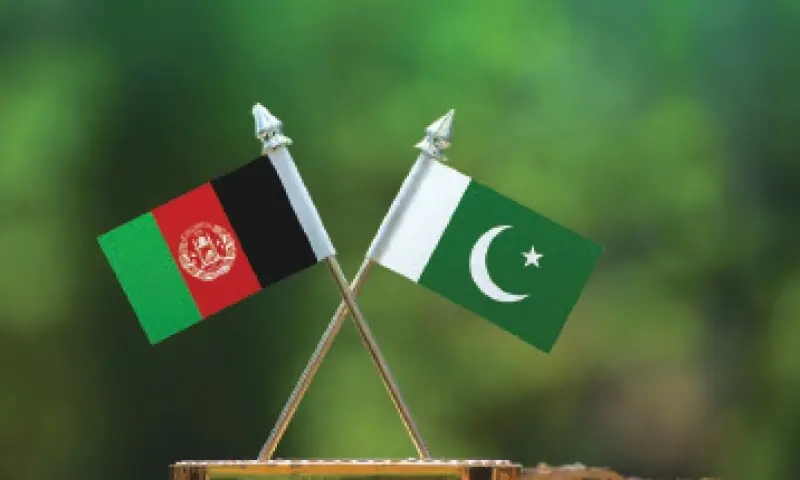
Economists have long understood that there many advantages to having close economic ties with neighbouring countries, provided that relations between them are broadly stable and they can behave as “good” neighbours.
In the case of Pak-Afghan relations, many would argue that the two countries are natural economic partners, starting with the fact that Afghanistan is a landlocked country in desperate need of international commerce and seaborne connectivity that can only be provided efficiently by either Pakistan or Iran.
Afghanistan also shares a border of more than 2,600 kilometres with Pakistan, and its main conurbations such as Kabul and Kandahar are close to the frontier, while border communities have historically thrived on both exports and imports from Pakistan. The straightforward logic that emerges from this is one of mutual benefit: Afghanistan needs reliable transit routes and Pakistan benefits from Afghan demand and transit activity. By extension, greater trade could generate employment and logistics activity while linking Pakistan’s seaports with Afghanistan and Central Asia.
Although this logic appears incontrovertible and would encourage commerce, bilateral trade remains below its potential, even as Pakistan has maintained institutional arrangements for economic engagement, including the Afghanistan-Pakistan Transit Trade Agreement and bilateral economic forums. After all, Pakistan has little economic reason to desire an isolated Afghanistan, and a stable neighbour would provide a larger market for Pakistani exporters and a route toward Central Asian markets. This would tie in very closely to Pakistan’s notion of geoeconomics as a driver of development.
But before prosperity, animated by vibrant commerce and exchange, what is required is peace, since any impulse towards geoeconomics is overridden by Pakistan’s responsibility to protect its citizens and territory.
Security concerns
In recent years, Afghanistan has become a hotbed of terrorist activity targeting the Pakistani state and its people, and the Afghan Taliban have failed to show the adequate resolve to deal with this serious cross-border issue. The principal concern is the Tehreek-i-Taliban Pakistan (TTP), which maintains a presence in Afghanistan and continues to conduct attacks against Pakistan, but there are various other rogue outfits that undermine regional security.
The United Nations itself has warned the Taliban to stop letting Afghan territory be used by the TTP and other terrorist organisations, but the pleas to reason appear to be falling on deaf ears, and Pakistan needs evidence that the Taliban will change course for the better.
Border control and bilateral commerce can only resume when the border is secure enough to remain open. Invariably, a peaceful Afghanistan would be a more reliable trading partner, a more valuable transit corridor and a far better basis for the regional connectivity from which both countries could benefit. Therefore, as Pakistan has argued at various fora, prosperity should be pursued, but never at the expense of peace.
The cost of terrorism
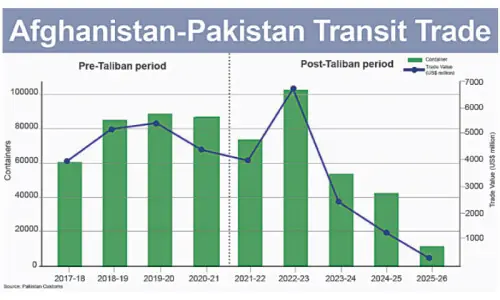
The deterioration in Pakistan–Afghanistan relations is visible in the trade figures. Official Pakistani data shows total merchandise trade reaching about $1.85 billion in 2022–23 before falling to $1.60 billion in 2023–24 and $1.38 billion in 2024–25. In other words, bilateral trade was 25 per cent lower in the previous year compared to the period after the fall of Kabul. Such figures are indicative of a dismal reality on the ground in Afghanistan.
As the World Bank has assessed, Afghanistan’s economy is in deep crisis, with rapid population growth, weak investment and structural constraints causing GDP per capita to decline by 5.6pc, even as the country faces a large trade deficit and remains heavily exposed to external shocks. As the World Bank further cautions, 14.8 million Afghans are facing food shortages, 4.7 million women and children suffering acute malnutrition, and nearly one in four young people unemployed. Why would a country in the direst straits globally, with the lowest human development levels, follow a path that makes it even poorer and more immiserated?
It should be noted that the costs of stalled commerce between both countries are highly asymmetric and are especially punitive for Afghanistan. While Pakistan loses commercial opportunities when trade is disrupted, it is Afghanistan that has much less capacity to absorb the shock because it is landlocked, economically fragile and dependent on external trade. Pakistan will matter to the Afghan economy no matter what, since it is the best and most important potential gateway for Afghanistan to international markets.
In that regard, the World Bank has identified prolonged border closures with Pakistan as a factor weighing on Afghanistan’s economy as it has documented an attempted shift in Afghan transit trade toward alternative routes. The Bank has further observed that Afghanistan’s import share from Pakistan declined as trade shifted toward other routes amid tensions and border disruptions.
Yet if Afghanistan thinks that it can use Iran and Central Asia as reasonable alternatives to Pakistan, then its economic conceptualisation is severely flawed. Iran is in the middle of a full-blown war against the United States and Israel, while Central Asia itself constitutes a landlocked part of the world. Therefore, these routes will not compensate for the importance that Pakistan naturally has for Afghanistan. Either way, alternative corridors mean longer distances, additional handling expenses and higher transportation expenses.
In addition, trade disruption means fewer working days for transporters, lower sales, higher prices for imported goods and potentially lower customs revenue. In an economy where poverty remains widespread and employment opportunities are limited, such shocks are highly damaging, and particularly as the world reels from the economic damage caused by conflict in the middle east.
The path forward
The mutually beneficial approach would be for the Afghan government to definitively stop allowing its territory to be used for terrorism against Pakistan for the future of Pak–Afghan economic relations ultimately depends on whether the latter chooses development or derailment. Connectivity requires security, and if Afghan territory continues to provide operational space for groups attacking Pakistan, Islamabad cannot treat economic integration as an unconditional obligation. Instead, and as Pakistan has repeatedly communicated, it can facilitate trade and transit only when the basic security conditions for those activities exist.
It is therefore helpful to map out how the Pak-Afghan economic relationship can be resuscitated in a sequential manner. First, Afghan authorities must provide verifiable assurances that Afghan territory will not be used for attacks against Pakistan and should take demonstrable action against the TTP and other militant organisations targeting Pakistan.
Second, Pakistan and Afghanistan should establish a permanent bilateral security and border mechanism to address militant activity, border incidents and the functioning of crossings. Its purpose should be rapid communication and de-escalation so that individual incidents do not become prolonged commercial crises.
Third, measurable security improvements should trigger progressive economic normalisation: predictable operating hours at legitimate commercial crossings, simpler customs procedures and arrangements that minimise losses when temporary restrictions are unavoidable.
Finally, the two countries should establish a Pakistan–Afghanistan Economic and Connectivity Commission with measurable targets: restoring bilateral trade to its previous peak and even exceeding it, increasing legitimate transit, reducing border-processing times and identifying investment opportunities. Regional connectivity infrastructure already demonstrates the potential for economic activity along the Pakistan–Afghanistan corridor. A sequential progression of this sort offers a win-win deal to both countries through a straightforward bargain: improved security produces greater scope for trade, transit and investment.
It is important to reiterate that Pakistan would not want to see an isolated neighbour whose government is keen to harbour terrorists while remaining mired in misgovernance that is starving and impoverishing the Afghan population.
Pakistan wants a western border that is peaceful, commercially active and connected to the wider region, and more importantly, Afghanistan has an even stronger economic interest in that outcome. It can remain caught in a cycle in which insecurity disrupts borders and damages commerce, or it can choose security, predictable trade and regional connectivity. For that, the Taliban must understand Pakistan’s position: the road to prosperity leads first through peace.