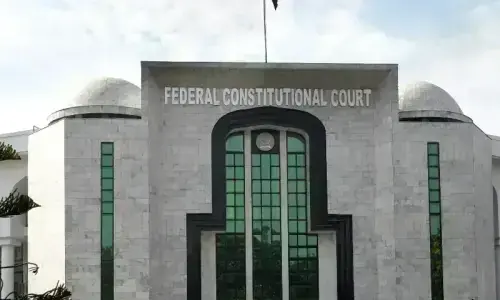
FCC frames rules on fundamental rights


• Habeas corpus petitions meeting prescribed requirements will be fixed for hearing as early as possible, within seven days of their filing
• No court fee on pleas in criminal matters
ISLAMABAD: The Federal Constitutional Court (FCC) on Thursday notified the Federal Constitutional Court (Practice and Procedure) Rules, 2026 under Article 191 of the Constitution to regulate its practice and procedure.
Part III, Order XXVI, prescribes the original jurisdiction of the FCC under Article 175E of the Constitution for the enforcement of fundamental rights.
The rules suggest that any petition for a writ of habeas corpus accompanied by an affidavit sworn by the person alleged to be restrained, also explaining that the petitioner has approached the concerned high court, will be fixed for hearing as early as possible and, in any case, no later than seven days from the date of its filing.
The rules state that no court fee will be payable on a petition for a writ of habeas corpus or on any other petition under Article 175E(3) of the Constitution arising out of criminal proceedings or proceedings connected therewith.
If the FCC is satisfied that a prima facie case for the grant of relief has been made out, it will issue a rule nisi calling upon the person or persons against whom the order is sought to appear on a date specified and show cause why the relief prayed for should not be granted. The court may also direct that the person alleged to have been illegally or improperly detained be produced before it.
In disposing of any petition or rule under this order, the FCC may, at its discretion, make such order as to costs as it considers just and proper.
Applications for the enforcement of fundamental rights other than a petition for habeas corpus should be supported by an affidavit verifying the facts relied upon and stating whether the applicant has approached the concerned high court for the same relief and, if so, with what result.
An application will be fixed for hearing on a date allowing at least eight clear days between the service of the notice of motion and the date of hearing.
Under the rules, the FCC may, during the proceedings, impose costs or require the furnishing of security as it deems proper.
The rules also provide for the power to call for the record of any case or proceeding from any authority for the purpose of satisfying itself as to the legality of the action under scrutiny. All petitions under this order will be dealt with expeditiously and, as far as practicable, decided within a reasonable time.
The FCC can take cognisance of contempt of court on its own motion or on a petition.
Among other matters, the court can take cognisance of scandalising or prejudicial contempt where the alleged contempt consists of words, spoken or written, or acts or visible representations that tend to prejudice a party to any proceeding before the court; scandalise or tend to scandalise the court or any judge; or otherwise tend to bring the court or a judge into hatred, ridicule or contempt.
Published in Dawn, October 2nd, 2026