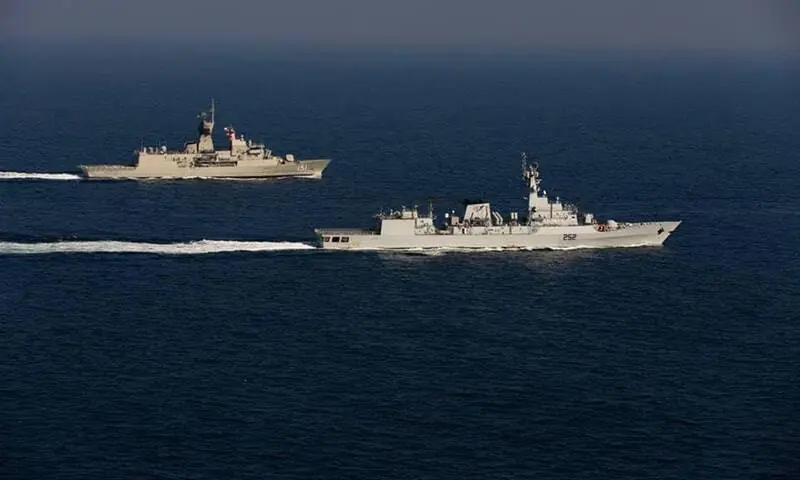

There is a particular kind of morning at Karachi’s harbour when the Arabian Sea seems to carry more than water; it carries intent. On such a morning in February 2025, warships from 60 nations sailed into Pakistani waters for AMAN, the Pakistan Navy’s biennial multinational exercise.
The exercise brought together naval forces from the Gulf Cooperation Council, Nato and the Shanghai Cooperation Organisation countries, offering a rare platform where the US, Russia, Iran and China could operate side by side in an apolitical setting.
Among the ships gliding past PNS Moawin, crews shouting the Nara-i-Takbeer as tradition demands, was Sri Lanka’s SLNS Vijayabahu. It was a small detail in a large spectacle, but it captured something larger: a friendship between two Indian Ocean states that has quietly matured into one of the more consequential, if under-appreciated, maritime partnerships in South Asia.
Pakistan and Sri Lanka do not share a border, a language, or a single dominant religion. What they share is a coastline on the same ocean, a history of standing by each other when few others would, and, increasingly, a strategic instinct that the Indian Ocean’s future should not be written by any one power alone. That instinct is now being translated into steel, sea legs, and spreadsheets.
Establishing a rhythm of presence
Pakistan’s naval diplomacy in the neighbourhood is not new, but its intensity has become undeniable. In 2026 alone, the two navies conducted the Lion Star exercises off Sri Lanka’s coast, followed almost immediately by Pakistani frigates PNS Taimur and PNS Aslat sailing onward to Malaysia for the MALPAK drills. The deployment marked the sixth edition of the MALPAK bilateral exercise, arriving fresh from successful drills with the Sri Lanka Navy, with the engagements connecting Colombo, Karachi and Lumut in a clear arc of sustained presence. That is not a courtesy visit. That is a navy establishing a rhythm of presence across the northern Indian Ocean, with Colombo as a deliberate waypoint rather than an afterthought.
Institutional ties back this up. The two countries held their fifth Armed Forces Defence Dialogue in Islamabad in April 2025 and conducted the bilateral counterterrorism exercise Shake Hands-II, while Pakistan extended roughly USD50 million in defence-related credit support to Sri Lanka, a modest sum by global standards, but a meaningful gesture from a country that has faced its own fiscal headwinds, and one that speaks to genuine solidarity rather than transactional convenience. And this month, as TRINEX-26 got underway off Trincomalee, Pakistani naval officers were again present, watching and learning alongside a Sri Lankan navy sharpening its own readiness.
None of this happens by accident. It happens because Pakistan has decided, correctly, that a stable and secure Sri Lanka, sitting astride the sea lanes that carry a large share of the world’s containerised trade, is a strategic asset for Pakistan and the wider region, not a rival’s backyard.
The economic opportunity
Security cooperation gets the headlines, but the more interesting story may be economic. Pakistan and Sri Lanka signed one of South Asia’s earliest bilateral free trade agreements back in 2005, and while the numbers are not staggering by global trade standards, the trajectory has been steady and instructive.
Pakistan’s exports to Sri Lanka rose from roughly USD154 million to nearly USD254 million between 2005 and 2020, while imports from Sri Lanka grew more modestly, widening Pakistan’s trade surplus from about USD95 million to over USD182 million over the same period. Cement, rice, textiles and pharmaceuticals flow one way; rubber, desiccated coconut and tea flow the other. It is unglamorous trade, but it is real, durable, and, crucially, largely untouched by the geopolitical turbulence that periodically disrupts other regional relationships.
The opportunity now is to extend this framework from goods into the blue economy properly defined: fisheries management, port logistics, marine research, and shipping services. Sri Lanka’s port infrastructure, forged by decades of experience at Colombo and Hambantota, is a natural complement to Pakistan’s Gwadar and Karachi ports. A Pakistan that is investing in becoming a regional maritime and logistics hub through Gwadar has every reason to see Colombo not as competition but as a partner node in the same network, sharing best practices on port efficiency, joint ventures in ship repair, and coordinated approaches to combating illegal, unreported and unregulated fishing that quietly bleeds both nations’ fish stocks.
Towards a genuine partnership
Critics will point out, fairly, that Sri Lanka also runs naval exercises with India and hosts a genuinely non-aligned defence posture. Indeed, Sri Lanka benefits from sustaining diversified defence relationships, balancing ties with India, Pakistan, and China to avoid excessive dependency on any single security partner. That is not a weakness in the Pakistan–Sri Lanka relationship; it is precisely what makes it credible.
Pakistan is not asking Colombo to choose sides. It is offering a genuine partnership grounded in professional respect, something Sri Lankan officers who train alongside Pakistani crews consistently describe when discussing the value of shared drills, search-and-rescue protocols, and counter-piracy tactics developed over years of Pakistan Navy experience in the Gulf of Aden and beyond.
That experience is not trivial. Pakistan has spent two decades helping secure some of the busiest and most dangerous shipping corridors on earth. A navy that has hosted 60 nations in a single exercise, that runs regular patrols from the Strait of Hormuz to the Strait of Malacca, has genuine expertise to offer a smaller island navy focused on securing its own waters against smuggling, illegal fishing, and the residual threats of extremism.
What Pakistan and Sri Lanka need now is not another dialogue but deliberate institutionalisation: a joint maritime security working group with a standing calendar of exercises, expanded coast guard cooperation on fisheries enforcement, and a serious push to update the two-decade-old trade agreement to explicitly cover maritime services and blue economy investment. The building blocks already exist with the treaties signed, ships exchanged and officers trained together. What remains is political will to connect security cooperation with economic ambition into a single, coherent strategy.
The Indian Ocean will only grow busier and more contested in the years ahead. Pakistan has shown, exercise after exercise, credit line after credit line, that it intends to be a serious, reliable partner for Sri Lanka in navigating that future, not as a patron, but as a fellow custodian of the same restless, valuable sea.