Tarar warns India's unilateral actions on IWT may have implications for water governance globally
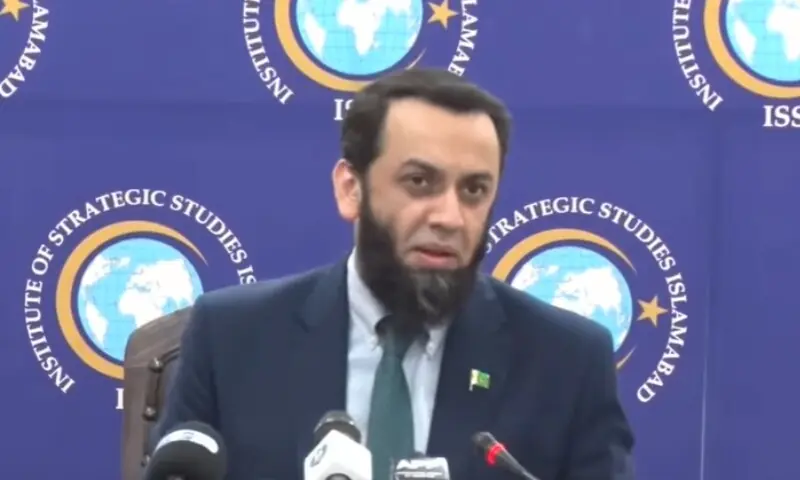

Information Minister Attaullah Tarar on Wednesday warned that India’s decision to hold the Indus Waters Treaty (IWT) in abeyance could have implications for global transboundary water governance, urging the international community to take note of the “wider precedent”.
Tarar made the remarks while addressing a ceremony organised by the Institute of Strategic Studies Islamabad to launch a report on the IWT issue.
Water and the IWT remain a contentious issue between India and Pakistan, following New Delhi’s unilateral abeyance of the accord in April last year — a move that was followed by a brief military conflict between the two sides in May 2025.
Following India’s move, Pakistan termed any attempt to suspend its water share an “act of war”, noting the IWT had no provision for unilateral suspension. It later argued that Delhi’s action was a violation of the 1969 Vienna Convention on the Law of Treaties.
“We are a peaceful nation, but we cannot allow India to weaponise water because it is the basic right of the 240 million people of Pakistan,” Tarar said, drawing attention to the “wider precedent involved”.
“If a state can unilaterally put a binding international water treaty in abeyance despite established dispute resolution mechanisms, the implications extend to transboundary water governance across the world,” Tarar warned, adding that it may have implications for countries sharing water under similar frameworks.
Tarar reiterated that Pakistan will continue to engage the international community and defend the country’s vital national interests.
At the outset of his address, Tarar said, “I take great pride in the fact that wherever we go, we say we are the people of the Indus Valley [..] we identify ourselves with the Indus waters.”
He noted that when the treaty was signed, the signatories “did not envisage that there would come a time a few decades down the line when conditions in India would deteriorate so much that they would be legally ignorant, morally bankrupt and devoid of ethics”.
Tarar held that the IWT was legally binding upon both parties. “It contains stipulations that this legal instrument cannot be unilaterally revoked, rescinded, or altered,” Tarar added.
He further stated that the treaty cannot be “unilaterally altered, revoked, rescinded or held in abeyance, for that matter, but even if there is a dispute, both the parties have to adhere to the terms and conditions of the treaty”.
At this, Tarar recalled an August ruling by the Permanent Court of Arbitration (PCA), saying, “The court upheld Pakistan’s stance, giving legitimacy and strength to the argument that there cannot be a unilateral attempt to change the status of this treaty”.
In its August order, the PCA had backed Pakistan’s stance, declaring that the IWT between the two countries remained fully in force, as India had no justification for ending or suspending the agreement.
Tarar further stated that Pakistan had approached the issue diplomatically: “We have engaged the international community and presented our point of view — legal and diplomatic — and as a nation-state, which respected the rights of others, in a manner that has been most effective.”
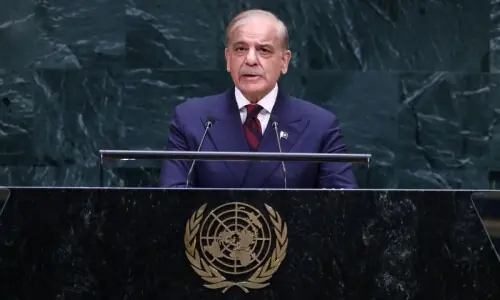
At this, the information minister recalled Prime Minister Shehbaz Sharif’s speech at the recent United Nations General Assembly (UNGA).
“PM Shehbaz said that the IWT is the lifeblood of our people and our region, and any attempt to usurp this right be treated as an act of war,” Tarar said.
Tarar stated that Pakistan’s position on the IWT remained “absolutely clear,” adding that the treaty was an “instrument of peace and stability for the region”.
He noted that India had justified its actions with “alleged cross-border terrorism”; however, he went on to highlight sacrifices made by Pakistan in the fight against terrorism.
“We have economic losses of over $50bn over the past many decades,” Tarar said.
He continued: “When one Pakistani citizen lays down their life, yes, it is to make Pakistan safe, but it also makes the world a safer place.”
Tarar, drawing a contrast with neighbouring India, said, “India has illegally tried to alter the status of the IWT and has been accused at the international level of transnational aggression”.
Shifting his attention back to the IWT, Tarar said India’s actions were “highly condemnable” and unjustifiable at a “legal, diplomatic, and moral level”.
The IWT allocates the eastern rivers — Ravi, Beas and Sutlej — to India, while the western rivers — Indus, Jhelum and Chenab — are largely allocated to Pakistan. The 1960 water-sharing agreement has also established mechanisms for data-sharing and dispute resolution.