The drive to Sanat Initiative takes you past the busy M.T. Khan Road, which leads to the bustling old city areas of Kharadar on one side and Karachi Port on the other. Past the traffic jam of heavy trailers and rickshaws, around flyovers, a detour branches to the quaint Miskeen Gali. Past this road with godowns on one side, but which still gives you the old neighbourhood vibe, you turn into Sanat’s gallery space, housed in a warehouse.
This location for Brooklyn-based artist Khalil Chishtee’s recent solo exhibition could not have been more appropriate. The expanse of the rough cemented ground, with minimal intervention to the warehouse structure, allows for the dismembered complexity of Karachi to momentarily enter the reading of the work.
The show ‘Nisbat Road to Troutman Street’ is a series of predominantly figurative, mixed media works constructed with grocery, trash and other bags through a layering, cutting and assemblage, in which the figure and metropolis emerge. The process of making, dismantling, peeling and un-peeling mirror Chishtee’s multilayered concerns. Thematically tied to the dislocation and disruption of his times, Chishtee and his artistic practice has journeyed long, going back to the 1960s, ’70s and ’80s.
As a boy in grade five or six, he was admitted to the painter Khalid Iqbal’s adult drawing classes, due to his exceptional figure-drawing skill. Iqbal took a figure drawing by Chishtee to Sadequain, who was working on a mural at a studio in Lahore’s Lawrence Gardens in the 1970s. Sadequain recognised the talent and invited Chishtee to draw in the same studio. This proximity no doubt provided a sensitivity to angst and the freedom to pursue his art with a similar aajizi [humility].
In his latest exhibition, Khalil Chishtee connects the streets of Lahore with the urban landscape of New York, exploring displacement, memory and renewal with plastic bags
Chishtee recalls the grand cinema market, billboard painters and wall-chalkings, posters on walls, posters pasted on top of posters, paintings on them and the graffiti culture around Nisbat Road and Lahore’s Walled City. As a pre-teen, he got early lessons on street culture and dissent, having painted the portrait of Z.A. Bhutto on several walls, before he saw them being whitewashed.
He was old enough to understand the political changes, as they were reflected on the streets. Chishtee is vary of authority and averse to convention, which is probably why he has never allowed his art to fall into a ‘style’. He is constantly revising the script, his art acutely personal, at times blatantly political and often injected with wry humour.
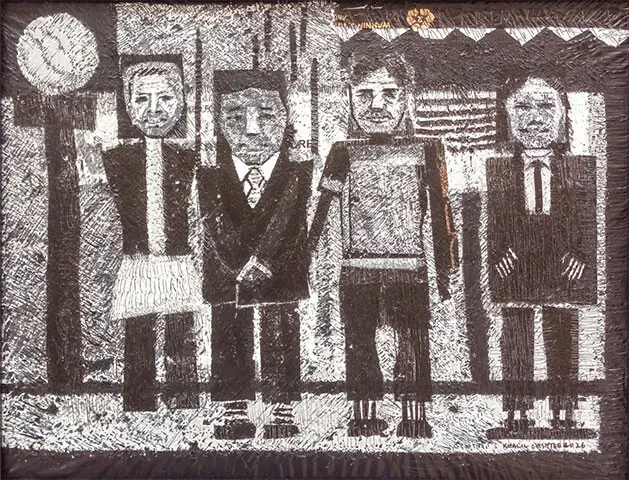
The figure transformed to his experimentation with plastic bags, which entered around 2005, when he visited New York and saw piles of trashbags that resembled human beings. The use of these bags became a critique on consumption and wastage, as well as a synopsis on repair and renewal. The bodies he sculpted also echoed the pain of illness that he had witnessed closely in his youth, something which I suspect allowed him to open his heart and soul to embrace the physical and emotional pain of others.
Displacement has not simply been a physical movement but an everlasting state, a friendship that has, in his words, been “beautifully painful and rewarding. It applies to that which is inside us and the experiences that never leave us. There is no cure, as nothing is ever lost.” Chishtee has often referenced Mirza Ghalib and, at this time, he reflects on Ghalib’s couplet Ghaib-i-Ghaib [Hidden of the Hidden], where Ghalib argues that what we call ‘reality’ is just an illusion or shadow.
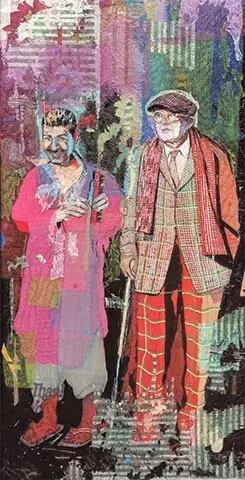
There is no lament for or romanticising of the past, for the present and past coexist in Chishtee. In fact, he retrieves the past from the present. It is no wonder then that in the artwork Men with Brushes, the artist David Hockney and a shoe-polisher from Nisbat Road find themselves on the same plane, as if they have just landed at an intersection at Times Square. The street iconography and vibrant culture in neighbourhoods around New York City, Bushwick and Brooklyn, where Chishtee has lived for the past 16 years, help him connect the dots to Nisbat Road.
Duality, whether it is a mirroring of the self or the other, is a recurring element, with figures referred to in titles such as Perfect Pair or Sage, Yet to Be — wise men conspiring and plotting. On closer look, one can read parts of text embedded in the image as an incidental part of the material. The titles help read into the intent of the artist and hint at multiple meanings, an important subtext in Chishtee’s art.
‘Nisbat Road to Troutman Street’ was on display at the Sanat Initiative in Karachi from September 8-17, 2026
The writer is an independent art critic, researcher and curator based in Karachi
Published in Dawn, EOS, September 27th, 2026