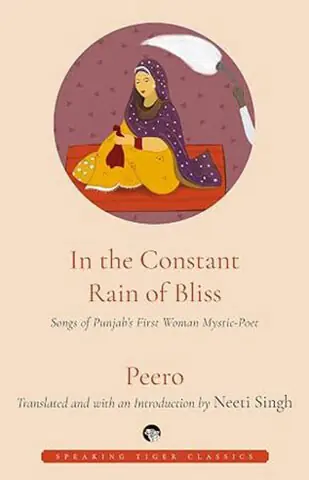
In the Constant Rain of Bliss: Songs of Punjab’s First Woman Mystic-Poet Peero
Translated by Neeti Singh
Speaking Tiger Books
ISBN: 978-9354471650
216pp.
The title In the Constant Rain of Bliss is drawn from the kaafi [devotional poem] which is translated as: “The birth is a portal, a boon, a gift! Rare and peerless is the body-mind, deep the secret seed, drenched and irrigated, in the constant rain of Bliss.”
Underlying these lines is a monist philosophy that disassembles traditional dualisms between body and mind; material and spiritual, including the divide between a guru and their disciple — ultimately God and creation.
Peero Preman (1832-1872/75), the 19th-century mystic-poet, affirms her deep love and devotion to her guru, Gulabdas. In Gulabdas, the physical and the transcendent converge seamlessly. He embodies both the singular metaphysical essence and the myriad earthly manifestations of the Divine. She says, “Creedless, casteless is saiyaan, neither Hindu nor Turk, neither woman nor man, free from the wheel of birth and death…”
Composed in Sadh Bhasha, a linguistic fusion of Punjabi, Braj Bhasha, Urdu and various Prakrit dialects, Peero utilises traditional Punjabi poetic forms, such as Kaafi, Siharfi, Baran Mah and Shabad. Synthesising Sufi, Bhakti and Advaita Vedanta values, her poetry remains inextricably connected to her own lived reality: that of a marginalised woman, a former courtesan who renounced both her profession and her religion. Anshu Malhotra, the historian, writes in Piro and the Gulabdasis, that Peero occupied a quadruple-disenfranchised position at the intersections of gender, class, religion and social status.
An English translation brings the poetry of the mystic Peero Preman to a wider audience, revealing a fearless voice that challenged orthodoxy and patriarchy
At its core, the “aesthetic sensibility” — a complex matrix of concepts, practices, and artistic expressions — is Punjabi. Readers familiar with Punjabi tradition will recognise classic forms like Kaafi, Siharfi, Barahmah, Hori and Shabad; uninitiated readers need context to appreciate their full depth. The volume addresses this need through an extensive 70-page translator’s introduction; it serves as a vital bridge into Peero’s world.
Neeti Singh’s translation of Peero’s verses into English is a “creative recreation”, blending fact, fantasy and deduction. The introductory essay, written in lyrical prose, weaves together biographical details. The narrative traces Peero’s life’s trajectory: her forced entry into the courtesan trade, her struggle for autonomy and her eventual flight to the dera [dwelling] of the charismatic saint Gulabdas.
Born into a Muslim family, she renounced her faith, withdrawing from an entire kinship network. This rift forms the central conflict in Peero’s life and poetry. Neeti Singh grounds Peero’s life in the socio-historical conditions of Ranjit Singh’s era and its courtesan culture, a background Peero repeatedly invokes in her work.
This unpacking of courtesan culture is crucial for unseating contemporary biases, as Neeti Singh emphasises: a courtesan of that era occupied a complex socio-artistic position and must not be reduced merely to an object of sexual subjugation.
In ‘Ik Sau Sath Kaafiyaan’ [160 Kaafis], the first poem, Peero speaks in the first person and, drawing upon rich Punjabi idioms, recounts the defining turning point of her life — her encounter with the charismatic Gulabdas in Lahore’s Moti Bazaar, followed by her dramatic escape from her captors. This poem, a dramatic and personal memoir, woven into the musical fabric of the kaafi, exhibits extraordinary hybridity.
However, the verse’s lingering power lies in Peero’s fearless critique of organised religion and patriarchal subjection. Confronting both Islamic clerics and Hindu pundits, she interrogates the arbitrariness of religious ritual: if a man’s faith is codified by circumcision or by wearing a moustache and shaving his head, where do women fit within these paradigms? Why are women systematically excluded from the very definitions of religious belonging?
Even more importantly, Peero packs the poem with allusions to classical mythological and mystic figures. She uses the myth of Sita’s rescue as a correlative for her own captivity and liberation, and summons Mansur al-Hallaj and Kabir, two celebrated mystical poets and spiritual figures. Ultimately, Peero’s verse creates a distinct poetic landscape that is at once personal and boldly public.
In other poems, Peero adopts the quintessential voice of a female devotee. The female persona of a longing lover, a virahini, is a foundational trope used across both Sufi and Bhakti traditions. The feminine aesthetic sensibility culminates in her Hori songs, which radiate collective joy and celebration. Because these festivities were actively staged at the Gulabdasi dera, these festive verses are dynamic texts that, in Neeti Singh’s words, present “the opera of celebration, scripted and directed by Gulabdas.”
Peero engages with traditional Barah Mah, a beautiful seasonal genre that pairs the changing characteristics of each month with the poet’s voice aching with longing. Here, she centres her devotion exclusively on Gulabdas. Through the scorching months of Chet, Vaisakh and Jeth, like a parched cuckoo crying for rain, the poetess yearns for a glimpse of her beloved. Conversely, in the fecund rains of Saavan, Peero, with her guru, celebrates the reunion.
Punjabi’s first female poet, Peero was featured in a seminal 1974 article, ‘Punjabi Di Pehli Stree Kavi’, by Dr Devinder Singh in Khoj Darpan, an academic journal published since 1973 by the School of Punjabi Studies at Guru Nanak Dev University in Amritsar, India. Her legacy also crossed into a play produced by Ajoka, which incorporated Peero’s original couplets.
Belonging to Chathian Wala, Kasur, Peero has attracted significant interest among Pakistani scholars, although her physical and archival presence remains precarious. Nothing survives of the Gulabdasi dera in Chathian Wala. My own recent visit to locate her samadhi [tomb] revealed a government school standing in place of the former sanctuary, with only a crumbling dome marking the resting place where Peero and her guru were interred.
Her poetry, unpublished and untranslated, remains largely absent from academic curricula in Pakistan. Sadly, this major edition, published in India by Speaking Tiger Books, will probably face cross-border distribution barriers, making it exceptionally difficult for Pakistani readers to access.
As a researcher working on Peero, I find that Neeti Singh’s work compellingly validates her singular voice and that it must be accessible, as she does not shy away from the explicit sensory, carnal and joyful dimensions of Peero’s life, although this may invite scholars to re-examine the traditional frameworks of mysticism. This is especially true since overly sanitised readings have reduced Sufi and Bhakti idioms, the lover-beloved and guru-disciple dynamics, to purely abstract, disembodied spiritual metaphors.
While Singh skilfully charts the synthesis of Sufi, Bhakti and Advaita currents in Peero’s thoughts, it is important to recognise that Sufism and Bhakti constitute a vast, heterogeneous landscape of sects, beliefs and practices. Peero represents a distinct, uninhibited place within this complex mystical continuum.
Bridging two languages as starkly different as Punjabi and English is an arduous task. As the Indian poet A.K. Ramanujan famously observed, the ideal translation seeks “to steer betwixt the two extremes of paraphrase and literal translation”, and this includes “keeping as near the author as one can.”
Does Neeti Singh achieve this delicate balance? Through my immersion in Peero’s poetry, I have found her diction deeply colloquial, directed by a “rhetoric of spontaneity.” While Singh methodically expands certain words to heighten aesthetic effect, significant omissions remain.
Her renderings of Siharfiyaan, simultaneously sensual and philosophical verses, appear fragmentary. Most crucially, the translations excise the bhanita, the signature closing line where Peero invariably inscribes her own name, addressing herself to seal the stanza. Furthermore, the work selected is incomplete.
Peero’s poetry is far more than an archival recovery of an early female poet; it is a living scripture of the Gulabdasi movement. Singh illuminates how Gulabdas and Peero coexisted as “profound mystics and reformist humanists.” Singh’s introduction reclaims a lost world of radical spiritual partnership, laying a crucial foundation for what must now be further retrieved in future poetic translations.
The reviewer is a PhD scholar working on Punjabi poets.
She can be contacted at ayesharamzan83@gmail.com
Published in Dawn, Books & Authors, September 20th, 2026