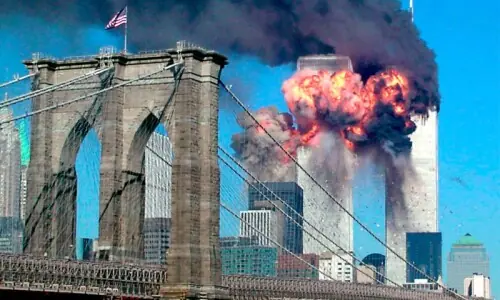
Lost opportunities post-9/11


Gen Z may know 9/11 from books, movies and videos, but millennials and older generations can still recall the horror of watching the second plane slam live into New York’s Twin Towers, followed by harrowing images of death and destruction.
A quarter-century later, the consequences of 9/11 still haunt the world. Pakistan, thrust overnight into a US-led war on terror, largely because of its proximity to Afghanistan, bore some of the heaviest fallout of the ensuing vengeful 20-year war.
Initially, the alliance ended Pakistan’s international isolation and unlocked desperately needed financial support. But those gains proved fleeting, while the costs endured. Beyond political and social fallout, persistent security challenges and economic losses disrupted Pakistan’s natural development trajectory, leaving it trailing many of its peers.
Dawn captured early signs of Pakistan’s post-9/11 transformation in two reports. A month after the attacks, it noted a marked easing of Western hostility and explored the potential gains for Pakistan. On the first anniversary, it documented the dramatic turnaround: sanctions lifted, Paris Club $12.5 billion debt rescheduled, over half a billion dollars in budgetary support, and a rush of Western dignitaries, including Prime Minister Tony Blair, US Secretary Colin Powell and US Defence Secretary Donald Rumsfeld. Against just five high-level visits in the last three months of 2000, Pakistan hosted over 50 VVIPS between Oct-Dec 2001.
‘Cheques bought us a decade. Preferential market access could have benefitted us for generations’
Looking back, Muhammad Ali Tabba, CEO, Lucky Cement and a leading industrialist, described 9/11 as both an economic lifeline and the beginning of a prolonged burden for Pakistan.
With foreign exchange reserves of barely $1.7bn, sanctions restricting international access and debt servicing under pressure, joining the US-led war on terror brought immediate relief. Sanctions eased, debt was restructured and multilateral support and other inflows provided badly needed breathing space.
“The longer-term costs, however, were far greater,” Mr Tabba said. Terrorism, military operations, travel advisories and instability raised Pakistan’s risk profile, discouraged investment, damaged infrastructure, increased business costs and diverted public resources to security and rehabilitation. Exports and tourism suffered, while losses in human capital, investors’ confidence and unrealised investment are impossible to quantify fully.”
Official estimates put the economic cost above $150bn, but Mr Tabba cautioned against blaming 9/11 for all Pakistan’s economic troubles. A narrow tax base, weak exports, underinvestment in education and policy inconsistency predated it.
Pakistan’s real problems were swept under the carpet, and when the honeymoon with the US ended, we had inadequate investment, no power, no gas, weak growth and high inflation. And the cycle continues’
“The real missed opportunity was failing to use the geopolitical importance, financial support and macroeconomic policy space to undertake structural reforms. The tragedy was that a temporary economic reprieve was never converted into stronger, more resilient economic foundation.”
Dr Ishrat Husain, former State Bank of Pakistan (SBP) governor and a key member of the Gen Musharraf government’s economic team, strongly defended its record, attributing the gains of the period to reforms rather than post 9/11 Western support.
“Between 2000 and 2007, the economy grew six to seven per cent, exports rose from $7bn to $17bn, debt-to-GDP halved, fiscal deficits remained at 3-4pc of the GDP, and the Federal Board of Revenue (FBR) revenues tripled. Foreign exchange reserves surged from $1.5bn to $13bn, and foreign direct investment peaked at $5bn. Private credit and concessional export financing also brought $5bn of investment in new textile machinery, while the current account remained in surplus for three years and close to balance otherwise.”
Dr Husain attributed the performance not to US dollar inflows but to structural reforms: fiscal consolidation, higher revenues, lower subsidies, containment of public-enterprise losses, tax reforms and automation, self-assessment and stronger FBR capacity. He argued that a stable exchange rate, low interest rates, and export incentives also supported investment and exports.
He cited Oxford researcher Matthew McCartney, whose study found little statistical evidence linking US aid inflows during Musharraf’s period with Pakistan’s savings, investment, imports, debt, corporate profitability or public investment. McCartney attributed the growth more to stronger domestic resource mobilisation and institutions.
Dr Hussain added that the gains, however, unravelled in 2008 as policy slippages combined with the global crisis, forcing the newly elected government to seek an IMF bailout.
Former Prime Minister and a leader of Awaam Pakistan Party Shahid Khaqan Abbasi stated: “The bottom line is that post-9/11 Coalition Support Fund (CSF) money flowed in and Pakistan provided cheap and easy credit to fuel consumerism. It took about 15 years for the cheap, plentiful dollars to dry up, and we ended up with current account and fiscal deficits because the focus had been on imports rather than increasing investment.
“Pakistan’s real problems were swept under the carpet, and when the honeymoon with the US ended, we had inadequate investment, no power, no gas, weak growth and high inflation. And the cycle continues.
People close to former prime minister Shaukat Aziz were currency changers who enjoyed direct access to his office, as they delivered $5-10 million every day, bought from local and Afghani sources, which the SBP sold in the market to feed consumption and maintain exchange-rate stability, said Mr Abbasi. “This is how Pakistan created a false semblance of stability and hollow economic progress.”
Zaid Bashir, Founder of Ideas, Gul Ahmed, and Chairman of the Pakistan Business Council, argued that the post-9/11 bargain was highly tilted against Pakistan. “We received roughly $20bn in aid and reimbursements, while the Finance Division puts the economic cost of war on terror comfortably above $120bn. More importantly, around 80,000 Pakistanis lost their lives. The world has never adequately recognised the price Pakistan paid”.
For Mr Bashir, however, money tells only part of the story. “In 2001 we sold something valuable at a bad time. Pakistan was close to default, under sanctions since 1999 and internationally isolated. When you are that weak, the buyer decides the price.” Aid eventually stopped, he said, but the consequences endured: a higher risk premium, lost investment, an insecure border, years of international sporting isolation and exodus of skilled Pakistanis.
Mr Bashir sees a recurring pattern. External money arrived at critical moments, in the 1960s, 1980s and after 2001, just when difficult reforms had become unavoidable. “Each time, it bought us time and allowed us to postpone reforms. Easy dollars became part of the problem; it buys time, but we never used that time well.”
He also regretted Pakistan’s failure to secure lasting market access. The proposed Reconstruction Opportunity Zones never materialised. “In 2001, Pakistan exported more than Bangladesh; today Dhaka is far ahead. Cheques bought us a decade. Preferential market access could have benefitted us for generations.”
The writer is a former Dawn staffer
Published in Dawn, The Business and Finance Weekly, September 14th, 2026